What is LEDs: Symbol, Structures, Working, Applications, and More
2025-12-03
4174
Catalog
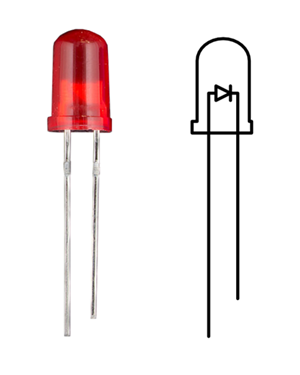
Figure 1. Light Emitting Diode
What is an LED?
An LED or Light-Emitting Diode is a semiconductor device that produces light when an electric current flows through it, a process known as electroluminescence. LED is built from a p-n junction material where electrons and holes recombine to release energy in the form of photons, creating light. The color of this light depends on the semiconductor materials used, allowing LEDs to be made in various colors, including visible, infrared, and ultraviolet. LEDs are highly energy-efficient, generate very little heat, turn on instantly, and have a long operational life, making them ideal for use in indicator lamps, displays, lighting systems, car headlights, and many everyday electronic devices.
Light Emitting Diodes Symbol
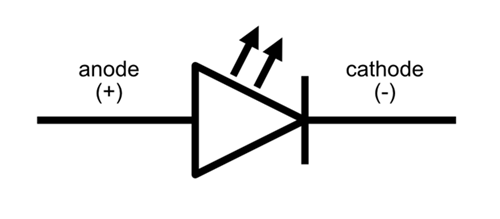
Figure 2. Light Emitting Diodes Symbol
The image shows the standard circuit symbol for an LED (Light-Emitting Diode). The left side of the symbol has the anode, represented by the triangular shape, which is the positive terminal where current enters the device. The right side has the cathode, shown as a vertical line, which is the negative terminal where current leaves. LEDs only light when current flows from the anode to the cathode, meaning they must be forward-biased. The two arrows pointing outward from the diode indicate that this component emits light, which is what distinguishes an LED from a regular diode.
Structure of Light Emitting Diodes

Figure 3. Structure of Light Emitting Diodes
The image illustrates the basic construction of an LED, showing how the device is built internally. Inside the transparent dome, there are two semiconductor regions: a P-type region and an N-type region. These form the PN junction, where light is produced. When the LED is forward-biased (the anode connected to positive and the cathode to negative), electrons from the N-type material and holes from the P-type material recombine at the junction. This recombination releases energy in the form of light, which is shown by the upward arrows in the diagram. The LED is housed inside a transparent cover, which allows the emitted light to escape while protecting the semiconductor. The base supports the internal structure and connects to the two external leads, the anode (+) and the cathode (–). This is a simplified but correct representation of an LED's internal structure.
Light Emitting Diodes Packaging

Figure 4. Light Emitting Diodes Packaging
This image shows a simplified view of LED packaging, highlighting the main parts that make an LED work. The ceramic substrate forms the base and provides mechanical support and good heat dissipation. On top of it sits the LED chip, which is the actual light-producing semiconductor. Thin bond wires connect the chip to the contact pads, allowing electrical current to flow into the device. A thermal pad helps remove heat generated by the chip to keep the LED cool and efficient. The entire structure is covered by a primary lens, a transparent dome that protects the chip and shapes the light coming out. This diagram provides an easy way to understand how a packaged LED is built internally.
How Light Emitting Diodes Works
An LED works by turning electrical energy into light. Inside it are two semiconductor layers, called P-type and N-type, which form a PN junction. When the LED is connected the right way, electrons and holes move toward each other and meet at the junction. As they recombine, they release energy in the form of light. The color of the light depends on the materials used in the LED. This simple process allows LEDs to produce bright light while using very little power.
Origin and History of Light Emitting Diodes
The idea behind LEDs began in the early 1900s, when H.J. Round noticed that some materials could glow when electricity passed through them. In 1927, Oleg Losev, a Russian inventor, studied this glowing effect in detail and created the first LED-like device, although it was not used in practical electronics yet. The first true, usable LED was created in 1962 by Nick Holonyak Jr., who made a small red-glowing LED. In the years that followed, researchers developed LEDs in more colors, and in 1972, George Crawford created a brighter yellow LED. Early blue LEDs also appeared in the 1970s, but they were very dim. The major breakthrough came in the 1990s, when Shuji Nakamura, Isamu Akasaki, and Hiroshi Amano developed bright blue LEDs using gallium nitride. This made white LEDs possible, which led to the energy-efficient LED lighting used widely in homes, offices, schools, and many other places today.
Light Emitting Diodes Biasing Circuit
To make an LED light up, it must be connected in forward bias. This means the positive side of the power supply connects to the anode, and the negative side connects to the cathode. When the LED is forward-biased, current flows through it and allows it to emit light. However, LEDs are very sensitive to high current. If too much current flows, the LED can burn out. To prevent this, a series resistor is added to the circuit. This resistor limits the current and keeps the LED safe.

Figure 5. LED Biasing Circuit
The value of the resistor can be found using the formula:
I = (Vs − Vd) / R
Where:
I = LED current
Vs = supply voltage
Vd = LED forward voltage (about 1.8–2.2V for red, 2.8–3.3V for white/blue)
R = resistor value
Most small indicator LEDs operate safely at 10–20 mA of current. High-power LEDs use more current, but they also require special drivers and heat sinks. If the LED is connected in reverse bias, it will not light, and applying too much reverse voltage can damage it.
Light Emitting Diodes Types
LEDs come in many types, and each one is made for a different purpose. Some are tiny indicators, others are very bright for lighting, and some can even change colors or produce invisible light. Below are the most common types of LEDs and what they are used for.
Miniature LEDs (Indicator LEDs) - These are the small LEDs you see in everyday devices. They are used as tiny lights that show whether something is ON or OFF. You can find them in remote controls, toys, chargers, and electronic panels. They do not need much power and usually glow using a small amount of current.
High-Power LEDs - High-power LEDs are made to produce very bright light. They can handle much more current than regular small LEDs. These LEDs are used in things like flashlights, car headlights, streetlights, and bright home lights. Because they get hot, they usually need a heat sink to stay cool.
SMD LEDs (Surface-Mount LEDs) - These LEDs are tiny and mounted directly on the surface of a circuit board. They are popular today and come in many sizes, such as 2835, 3528, 5050, and 5630. SMD LEDs are used in LED strip lights, TV backlights, signs, and most modern LED bulbs. They are known for being bright and efficient.
COB LEDs (Chip on Board) - COB LEDs have many small LED chips grouped tightly together on a single board. Because the chips are close to each other, they give off a strong, even light with no visible “dots.” They are found in spotlights, floodlights, lamps, and other lighting that needs a wide, smooth glow.
RGB LEDs - RGB LEDs contain three colors inside one LED: Red, Green, and Blue. By mixing these three colors, they can make almost any color you want. They can change colors smoothly and are applied in decorative lights, LED strips, gaming setups, stage lighting, and colorful displays.
IR LEDs (Infrared LEDs) - IR LEDs give off light that we cannot see because it is in the infrared range. Even though we can’t see it, devices can. That is why IR LEDs are seen in remote controls, night-vision cameras, automatic doors, and many different types of sensors.
UV LEDs (Ultraviolet LEDs) - UV LEDs produce ultraviolet light, which is also invisible to our eyes. These LEDs are used for sterilizing water and surfaces, drying or curing resin, checking fake money, and in scientific tools. They must be handled carefully because too much UV light can be harmful.
Bi-Color and Tri-Color LEDs - Bi-color LEDs have two colors in one LED. Tri-color LEDs have three colors. They can switch colors or show mixed colors depending on how they are connected. These LEDs are used in signs, dashboards, indicators, and simple display boards.
Flashing LEDs - Flashing LEDs blink by themselves. They have a small built-in circuit that makes them turn on and off automatically. They are employed in toys, small warning lights, decorations, and simple signaling devices.
OLEDs (Organic LEDs) - OLEDs are made from special organic (carbon-based) materials that glow when electricity passes through them. These LEDs can be extremely thin, flexible, and give off bright, sharp colors. They are applied in modern TVs, smartphones, smartwatches, and high-quality display screens.
LED I-V Curve Characteristics
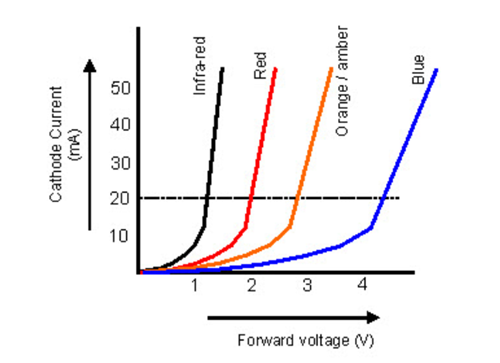
Figure 6. LED I-V Curve Characteristics
The I-V curve of an LED shows how much current flows through it at different voltage levels, and it helps explain how an LED works in a circuit. When an LED is connected in forward bias (anode to positive, cathode to negative), very little current flows at first. Once the voltage reaches the LED’s forward voltage, usually about 1.6–2.0 V for red, 2.0–2.2 V for yellow and amber, 2.0–3.2 V for green, and 2.8–3.6 V for blue and white, the current rises quickly. Because this current increases so sharply, a resistor or constant-current driver is needed to protect the LED from too much current. In reverse bias (connected backward), almost no current flows, but too much reverse voltage can damage the LED because LEDs are not designed to block high reverse voltages. Different LED colors have different I-V curves because each color uses a different semiconductor material, which gives it a different forward voltage.
Advantages & Disadvantages of LED’s
Advantages of LEDs:
Use Less Power - LEDs use much less electricity than other bulbs.
Last a Long Time - They can work for many years before needing replacement.
Very Bright - LEDs can produce strong, clear light in many colors.
Stay Cool - They do not get very hot, making them safer to use.
Tough and Durable - LEDs are hard to break because they have no fragile parts.
Environment-Friendly - They save energy and do not contain harmful materials.
Turn On Instantly - LEDs light up immediately with no warm-up time.
Small Size - They can be made very tiny for many different devices.
Disadvantages of LEDs:
Higher Cost at First - They cost more to buy than regular bulbs.
Can Be Affected by Heat - LEDs may not work well if they get too hot.
Need a Current-Limiting Resistor or Driver - Without proper current control, the LED can burn out.
Light Can Change Over Time - Some LEDs may slowly change color or become dimmer with age.
Directional Light - LEDs shine light in one direction, so extra parts may be required to spread the light.
Applications of Light Emitting Diode
Indicator Lamps - Used in gadgets like chargers, TVs, and computers to show power status or activity.
Electronic Displays - Found in phone screens, digital clocks, scoreboards, and outdoor signboards.
Lighting Systems - Used in homes, offices, streets, flashlights, and car headlights because they provide bright, efficient light.
Traffic and Safety Signals - Used in traffic lights, vehicle brake lights, turn signals, and warning signs due to their quick response time.
Backlight Sources - Used behind LCD screens in monitors, TVs, and instrument panels to improve visibility.
Infrared Devices - Infrared LEDs appear in remote controls, night-vision cameras, automatic doors, and various sensors.
Medical and Scientific Tools - Used in UV sterilizers, dental equipment, phototherapy units, and lab instruments.
Communication Technology - Applied in fiber-optic systems to send information as light signals.
Decorative Lighting - Applied in LED strips, mood lighting, stage lights, and holiday decorations for colorful effects.
Automotive Electronics - Found in dashboards, interior lights, headlights, and signal lamps because of their long life and reliability.
Diode vs LED Comparison
|
Feature |
Diode |
LED
(Light Emitting Diode) |
|
Definition |
Allows current to
flow in one direction |
Emits light when
current flows through it |
|
Main Use |
Rectification,
protection, switching |
Lighting, indicators,
displays |
|
Light Output |
Does not produce
visible light |
Produces visible, IR,
or UV light |
|
Forward Voltage |
Low: 0.3–0.7 V |
Higher: 1.6–3.6 V
(depends on color) |
|
Materials |
Silicon or germanium |
GaAs, GaP, GaN,
InGaN, AlGaInP, etc. |
|
Current Control |
Less sensitive; often
no resistor needed |
Needs a resistor or
driver to limit current |
|
Heat Production |
Low heat |
Produces light and
some heat |
|
Response Time |
Slower than LED |
Very fast, lights
instantly |
|
Cost |
Usually cheaper |
Higher cost than
regular diodes |
|
Applications |
Power supplies,
clipping, rectifiers |
Lamps, indicators,
traffic lights, screens |
LED Bulbs vs Traditional Bulbs
LED bulbs are much more efficient than traditional bulbs because they use less electricity, last far longer, and produce very little heat. They are also durable and eco-friendly. Traditional bulbs may cost less to buy, but they use more power, burn out faster, and can get very hot.
|
Feature |
LED
Bulbs |
Traditional
Bulbs (Incandescent / Halogen / Fluorescent) |
|
Energy Use |
Very low energy
consumption |
Use much more
electricity |
|
Lifespan |
Long life
(15,000–50,000 hours) |
Short life
(1,000–8,000 hours) |
|
Heat Output |
Stay cool; little
heat |
Produce a lot of heat |
|
Brightness |
Bright and efficient
with less power |
Need more power for
the same brightness |
|
Cost |
Higher initial cost |
Cheaper to buy |
|
Running Cost |
Very low (saves money
over time) |
High electricity cost |
|
Durability |
Strong and
shock-resistant |
Fragile; break easily |
|
Environmental Impact |
Eco-friendly, no
mercury |
Some types contain
mercury (fluorescent), waste more energy |
|
Switching On/Off |
Instant on, no
warm-up time |
Some need warm-up
(fluorescent) |
|
Color Options |
Many colors and tones
available |
Usually limited to
warm or cool whites |
|
Heat Safety |
Safe to touch; low
risk of burns |
Can get extremely hot |
|
Light Direction |
Directional (focused
light) |
Non-directional
(light spreads everywhere) |
Conclusion
LEDs are important because they save energy, last a long time, and give bright light. They are now used almost everywhere, from simple indicators to home lighting and large displays. Understanding how LEDs work helps us see why they are main in today’s technology.
 ABOUT US
Customer satisfaction every time. Mutual trust and common interests.
ABOUT US
Customer satisfaction every time. Mutual trust and common interests.
function test. The highest cost-effective products and the best service is our eternal commitment.
Hot Article
- LM358 Dual Operational Amplifier Comprehensive Guide: Pinouts, Circuit Diagrams, Equivalents, Useful Examples
- Are CR2032 and CR2016 Interchangeable?
- Understanding the Differences ESP32 and ESP32-S3 Technical and Performance Analysis
- Choosing the Right Battery: A Guide to AG4, LR626, LR66, 177/376/377, SR626, and SR626SW Equivalents
- BC547 Transistor Basics: Pinout, Application Circuits, Alternative/Complementary Models
- NPN vs. PNP: What's the Difference?
- esp32 vs stm32: which microcontroller is better for you?
- What Is a MOSFET and How It Works?
- Electrical Relay Basic: Working Operation, Types and Uses
- PNP Transistors: Structure, Working Principle and Application
 Understanding Magnetic Proximity Sensors Features, Types, and Applications
2025-12-04
 Thermal Paste Guide: What It Is, How It Works and How to Use It Right
2025-12-03
Frequently Asked Questions [FAQ]
1. What makes LED lights more energy efficient than other light sources?
LED lights use the majority of electrical energy to produce light, not heat. This means very little energy is wasted so they can produce bright light while using much less electricity than older light bulbs.
2. Why do LED lights have a much longer lifespan?
LEDs do not have a filament or gas. Instead, they use a solid material that wears away over the years, which is why LEDs can continue to operate for very long periods of time.
3. Why do LED lights look different even at the same brightness?
Different LED colors come from different materials and wavelengths of light. Our eyes also see some colors brighter than others, so even if two LEDs have the same wattage, they may look different.
4. Are LED lights safe for the eyes?
Yes, most LED lights are safe. However, LED lights that are too bright can cause eye strain if you look directly at them. It's better to use a diffuser or visor to make the light softer on the eyes.
5. Why do some LED lights flash?
Flickering LEDs often occur when the power supply is unstable or when the LED driver is of low quality. It can also occur with dimmer switches not intended for LEDs.
6. Why do LED bulbs fail?
Most LED failures occur due to heat or poor quality components. If the LED is too hot or the driver is damaged, the LED may stop working sooner than expected.
Hot Part Number
 C1608X7R1E474K080AB
 C2012X5R0J225K085AA
 GRM0225C1E4R1CDAEL
 CC0603ZRY5V6BB474
 UMK316B7474ML-T
 08051U150GAT2A
 GRM1886S1H1R1CZ01D
 T495D476K010ATE080
 TPSE106M050R0500
 APA600-PQ208
- MT47H64M8CF-25E:G
- MC9S12XA512VAL
- IS42S16160B-6TL
- SI8233AD-D-IS
- RT0402DRD072K49L
- CY8C20140-SX2I
- VLF4012AT-100MR79
- SKM150GAL128D
- MC100ELT21DR2G
- MC14040BDTR2G
- LT3971AIMSE#PBF
- T491D107K006ZT7280
- UCC3818N
- INA240A2PW
- IXFP22N65X2M
- LT1999CMS8-50F#PBF
- SN74LVC32ADR
- AD5262BRUZ20-RL7
- ATMXT1666T2-C2U
- BU20360-48L
- ICS950218AFT
- MAX1779EUE+TG104
- MAX202ECWE-T
- MAX8860EUA27
- G5LA-1A4-12V
- HN29V256AOBBP-30
- M66445M1FA
- NFP-2200-A3
- PCD8010H/E31/4
- PEAD22653AFV1QH14NAR
- 6MBP150RTM060
- S29GL032A90FAIR43
- TMR3-1211
- T6TD7XBG-0001
- CS242C001PZ-TRSV
- IBMPPCBWY-GES72914
- SDINBDG4-8G-XI1
- XFL4020-332MEC
- GMOV-14D500K