What Is an Air Ionizer and How Does It Clean the Air
2026-02-16
2065
Catalog

Figure 1. Plug-in Air Ionizer
Air Ionizer Overview
An air ionizer is a device made to improve indoor air quality by releasing negatively charged ions into the air. These ions attach to airborne particles such as dust, pollen, smoke, and pet dander. Once electrically charged, the particles become heavier and cluster together.
As a result, they fall to the ground or stick to nearby surfaces, reducing the number of particles floating in the air. Unlike traditional air purifiers that use filters to capture contaminants, ionizers rely on an electrical process called ionization and do not physically trap particles. Some models operate as standalone plug-in devices, while others are integrated into fans, air conditioners, or HVAC systems.
Who Created the Ionizer?
The air ionizer was not invented by only one person. Ionizer developed over time as people learned more about electricity and charged air particles. In the 1700s and 1800s, Michael Faraday and J. J. Thomson helped explain how electricity and ions work. Later, Alfred P. Chattock and Robert J. Van de Graaff studied high-voltage electricity and how charged particles move in the air. Their work helped create the base for ionizer technology.
In the early 1900s, Alexander Chizhevsky designed one of the first air ionizers. He studied how negative ions affect the air and people’s health. His device was sometimes called the “Chizhevsky chandelier.”
Modern air ionizers are based on many years of study and improvements in electrical technology.
How Does an Ionizer Work?
An air ionizer works by using electricity to create negatively charged ions. Inside the device, a high-voltage component produces a small electrical charge. This process is called corona discharge, which releases negative ions into the surrounding air. These negative ions attach to tiny airborne particles such as dust, pollen, smoke, and pet dander. When the particles gain an electrical charge, they attract each other and stick together. As they combine, they become heavier.
Since the particles are now larger and heavier, they fall to the ground or stick to nearby surfaces like walls and furniture. This reduces the number of particles floating in the air. Unlike HEPA air purifiers, ionizers do not trap particles in a filter. Instead, they cause pollutants to settle, which means regular cleaning of surfaces is still needed for best results.
How Does an Ionizer Work on a Fan?
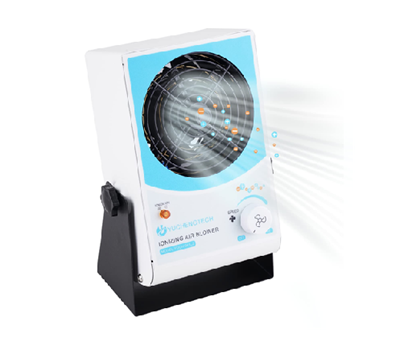
Figure 2. Ionizer on a Fan
When a fan has a built-in ionizer, it does two jobs at the same time. The fan blows air around the room, and the ionizer releases negative ions into that moving air. Since the air is constantly moving, the ions can spread faster and reach more areas of the room.
The negative ions attach to tiny particles in the air, such as dust, pollen, smoke, and pet hair. These particles are very light and usually float in the air. When the ions stick to them, the particles get an electric charge. This makes them stick to each other and form larger clumps.
As the particles become larger and heavier, they can no longer float easily. They fall to the floor or stick to nearby surfaces like walls, tables, and curtains. This helps reduce the amount of dust and other particles in the air you breathe.
Types of Ionizers
There are several types of air ionizers. Each type works in a slightly different way, depending on how it releases ions and how it handles airborne particles.
Negative Ion Generator (Single-Polarity Ionizer)
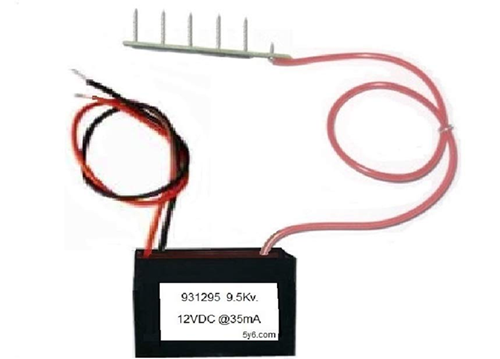
Figure 3. Negative Ion Generator
Negative Ion Generator is the popular type of air ionizer. Negative Ion Generator releases only negative ions into the air. These ions attach to small airborne particles such as dust, pollen, smoke, and pet dander. When the particles become charged, they stick together and become heavier. Since they are heavier, they fall to the ground or stick to nearby surfaces. This type is found in small plug-in devices and portable units used in homes or bedrooms. It is simple in design and usually low in power consumption.
Bipolar Ionizer (Positive and Negative Ionizer)
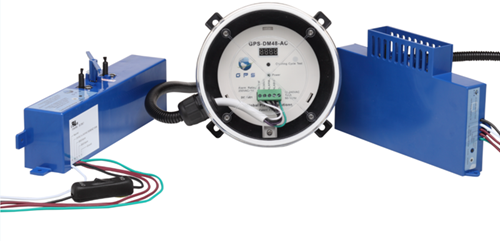
Figure 4. Bipolar Ionizer
Bipolar Ionizer releases both positive and negative ions into the air. The opposite charges help particles attract each other more quickly. This makes particles combine faster and settle out of the air more effectively. Bipolar ionizers are installed in HVAC systems for homes, offices, schools, and commercial buildings. They are designed to cover larger areas and work with existing air circulation systems.
Plasma Ionizer (Cold Plasma Ionizer)
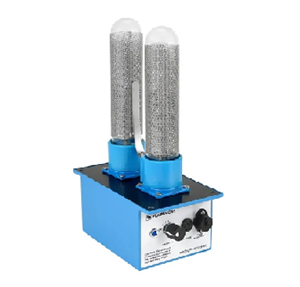
Figure 5. Plasma Ionizer
Plasma Ionizer use a stronger electrical field to create a mix of charged particles, sometimes called plasma. This type can help reduce airborne particles and may also help reduce odors. Plasma ionizers are found in more advanced air purification systems. Plasma Ionizer are used in larger spaces or in systems that require higher air treatment performance.
Electrostatic Precipitator (ESP)
This type not only charges airborne particles but also collects them inside the device. Once the particles are charged, they are pulled toward metal collection plates inside the unit. Unlike basic ionizers where particles settle on surfaces, ESP systems trap the particles inside the device. However, the collection plates must be cleaned regularly to keep the system working properly.
Ionizer vs Air Purifier Comparison

Figure 6. Ionizer vs Air Purifier
|
Feature |
Ionizer |
Air
Purifier (HEPA Type) |
|
How It Works |
Releases negative
ions that attach to airborne particles. |
Pulls air through
filters to trap particles inside the unit. |
|
Particle Removal
Method |
Makes particles
heavier so they fall to surfaces. |
Physically captures
and holds particles in a filter. |
|
Filter Required |
No filter needed. |
Uses HEPA or other
filters that need replacement. |
|
Maintenance |
Requires regular
surface cleaning. |
Requires periodic
filter replacement. |
|
Effectiveness for
Fine Particles |
Moderate; particles
settle but remain in the room. |
High; removes fine
dust, allergens, and some bacteria. |
|
Odor Reduction |
Limited odor
reduction. |
Better odor control
when combined with carbon filters. |
|
Noise Level |
Usually very quiet. |
Can produce fan noise
depending on speed. |
|
Energy Use |
Low power
consumption. |
Higher power use due
to fan and motor. |
|
Best For |
Small rooms and light
air cleaning. |
Allergies, asthma,
and stronger air purification needs. |
Applications of Ionizer
Homes - Ionizers can be placed in bedrooms, living rooms, or small apartments. They help lower the amount of floating dust and may improve comfort for people sensitive to allergens.
Offices - In office spaces, ionizers help reduce airborne particles and support a fresher indoor environment. They may be installed in work areas, meeting rooms, or shared spaces.
HVAC Systems - Some ionizers are built into heating and cooling systems. These units release ions through air ducts to treat larger spaces such as schools, commercial buildings, and healthcare facilities.
Vehicles - Compact ionizers fit inside cars and help reduce smoke, odors, and dust inside the cabin.
Industrial Environments - In certain factories and workshops, ionizers assist in controlling airborne particles and reducing static electricity in sensitive areas.
Advantages & Disadvantages of Ionizer
Advantages of Ionizer:
• Ionizers help lower the number of floating particles such as dust, pollen, smoke, and pet dander.
• Most ionizers operate without a fan, so they produce very little noise.
• These devices usually require less electricity compared to large air purifiers.
• Ionizers do not use HEPA filters, so there is no need to buy or replace filters regularly.
• Many models are small and easy to place in bedrooms, offices, or cars.
Disadvantages of Ionizer:
• Particles settle on floors and furniture instead of being collected inside the device. Regular cleaning is still required.
• Ionizers may not remove very fine particles as effectively as HEPA air purifiers.
• Some ionizers can produce small amounts of ozone, which may cause irritation in high levels.
• In bigger spaces, performance may be reduced without proper airflow.
Best Place to Install an Ionizer
Near Airflow - Place the ionizer where air can move freely, such as near a fan, air conditioner, or open space. Good airflow helps distribute the ions throughout the room.
Bedroom or Living Room - These areas are ideal since we spend more time in bedroom or living room. Position the device a few feet away from where you sit or sleep for better air circulation.
Inside HVAC Systems - For larger spaces, ionizers can be installed inside heating and cooling ducts. This allows ions to travel through the entire building.
Avoid Corners and Obstacles - Do not place the ionizer behind furniture or in tight corners. Blocked airflow reduces performance.
Vehicle Placement - In cars, plug the ionizer into a power outlet and place it where air circulates freely, such as near the dashboard vents.
How to Test if an Ionizer Is Working
Testing an ionizer can be simple, even though negative ions cannot be seen. First, check if the power indicator light is on to make sure the device is receiving electricity. You can also place your hand a few inches away from the ion outlet to see if you feel a slight static sensation. After running the ionizer for several hours or days, you may notice more dust settling on nearby surfaces, which can show that airborne particles are being charged and falling. Some units produce a faint buzzing sound, which means the internal electrical system is working. For a more accurate test, an ion counter can measure the number of ions in the air and confirm proper performance.
Conclusion
Air ionizers release negative ions that attach to airborne particles and make them fall to surfaces. They can help lower the amount of dust and other particles in the air. Before buying one, think about room size, features, and maintenance. Understanding how an ionizer works will help you decide if it is the right choice for your space.
 ABOUT US
Customer satisfaction every time. Mutual trust and common interests.
ABOUT US
Customer satisfaction every time. Mutual trust and common interests.
function test. The highest cost-effective products and the best service is our eternal commitment.
Hot Article
- LM358 Dual Operational Amplifier Comprehensive Guide: Pinouts, Circuit Diagrams, Equivalents, Useful Examples
- Are CR2032 and CR2016 Interchangeable?
- Understanding the Differences ESP32 and ESP32-S3 Technical and Performance Analysis
- BC547 Transistor Basics: Pinout, Application Circuits, Alternative/Complementary Models
- Choosing the Right Battery: A Guide to AG4, LR626, LR66, 177/376/377, SR626, and SR626SW Equivalents
- NPN vs. PNP: What's the Difference?
- esp32 vs stm32: which microcontroller is better for you?
- What Is a MOSFET and How It Works?
- Electrical Relay Basic: Working Operation, Types and Uses
- PNP Transistors: Structure, Working Principle and Application
 Flux Capacitor Guide to Its Invention, Function, Cost, and Uses
2026-02-16
 What is a Voltage Follower? Operation, Applications & Design Guide
2026-02-16
Frequently Asked Questions [FAQ]
1. Do air ionizers remove mold spores from the air?
Ionizers can cause mold spores to settle onto surfaces, but they do not destroy or fully remove them from the room. Surface cleaning is still required.
2. Can an air ionizer help with asthma symptoms?
It may reduce airborne triggers like dust, but HEPA air purifiers are generally more effective for asthma management.
3. Do ionizers kill viruses and bacteria?
Basic ionizers mainly cause particles to settle. Some advanced bipolar systems may reduce certain microbes, but results vary by model.
4. Are air ionizers safe for pets?
Most low-ozone ionizers are safe for pets when used properly. Always check ozone emission levels before use.
5. Can ionizers remove cigarette smoke completely?
Ionizers can reduce smoke particles in the air, but they may not fully remove strong smoke odors without additional filtration.
6. Do air ionizers leave black marks on walls?
Some models may cause dark dust buildup near the unit due to particle settling. Regular cleaning prevents staining.
Hot Part Number
 CGA9N3X7S2A106K230KB
 C3216X7S0G476M160AB
 CL05B562KA5NNNC
 CGA3E3X8R2A333M080AD
 1206PC473KAT2A
- CL10C151GB8NNWC
 GCM1555C1H391JA16D
 GRM1885C2A8R0DA01J
 GQM2195C1H470GB01D
 GRM0336R1E1R2CD01D
- T510E108M004AS4115
- BZT52C5V1T-7
- 843252AGLFT
- RTC-72421B
- LAN9514-JZX-TR
- XRT86VX38IB256-F
- VI-JT3-EW
- EP1S25F1020C5
- S912B32E4VFUE8R
- V48C12C150B
- V300A48M500BL
- 6MBI35S-140-50
- NCV2903DMR2G
- CAT3200ZI-GT3
- ADG721BRMZ-REEL
- T491D106M035AT7128
- F6KA2G605A4LA-Z
- AD9226ARSZRL
- ADS8341EB
- LC898212XD-SH
- TPS2541RTET
- LP2953IM-3.3
- ADF4106BRUZRL
- ATAR862N-087-TNQ38
- BCM5751MKFBG
- BQ20881DBTR
- EL2120CS
- K4B4G1646E-BCK0
- M5M5V108DKV-70HI
- MC14051BCP
- MPC993FA
- PI3HDMI2410-AFFE
- XCS20XL5TQ144C
- APA2621RI-TRG
- DS24B33S+T&R
- IDT71V321L25TFI
- RTL8366S-VS-GR
- SKKT215/16E
- EXO-3C16MHz