What Is an Accelerometer: How They Work and Where They Are Used
2025-12-16
2653
Catalog

Figure 1. Accelerometer
Accelerometer Overview
Accelerometer is a sensing device that measures movement. Accelerometer can tell when something moves, shakes, tilts, speeds up, or slows down. Accelerometer also senses the pull of gravity, which helps detect direction and position. Inside an accelerometer is a tiny part that moves when the device moves. When this part moves, the sensor changes it into an electrical signal. This signal tells how strong the movement is and which way it is going. Accelerometer can determine whether an object is speeding up, slowing down, tilting, or vibrating.
How an Accelerometer Works
As stated above, an accelerometer works by sensing movement and changes in motion and converting them into an electrical signal. Inside the device is a very small internal mass that responds when motion, vibration, or force is applied. When the device experiences acceleration, this mass shifts slightly, causing a change in an electrical property such as capacitance, resistance, or electric charge, depending on the sensor design.
The accelerometer measures this change along one, two, or three axes, allowing it to detect direction, vibration, and orientation. Gravity also affects the internal mass, which makes it possible to sense tilt and position. The small electrical signal produced by the sensor is then amplified, filtered, and processed by internal circuits before being sent to a control system or processor. This processed signal allows electronic systems to accurately monitor motion, detect vibration, and respond to changes in speed or direction in real-world applications.
Accelerometer Performance & Specifications
|
Specification |
Simple
Description |
|
Measurement Range |
The maximum
acceleration the sensor can measure, usually shown in g. |
|
Sensitivity |
How much the output
changes when movement changes. Higher sensitivity detects small motion. |
|
Accuracy |
How close the reading
is to the real acceleration value. |
|
Resolution |
The smallest movement
the sensor can detect. |
|
Noise Level |
Unwanted signal
changes that can affect clear readings. |
|
Frequency Response |
How well the sensor
detects slow and fast movements. |
|
Bandwidth |
The range of motion
speeds the sensor can measure accurately. |
|
Axis Configuration |
The number of
directions the sensor can measure (1-axis, 2-axis, or 3-axis). |
|
Output Type |
Type of signal
produced, such as analog or digital. |
|
Operating Temperature
Range |
Temperature range
where the sensor works properly. |
|
Shock & Vibration
Resistance |
How much impact or
vibration the sensor can handle without damage. |
|
Power Requirements |
The voltage and
current needed for the sensor to operate. |
|
Environmental
Protection |
Protection against
dust, moisture, and electrical interference. |
Power Requirements of Accelerometers
• Supply Voltage – The electrical voltage needed for the accelerometer to work, such as 3.3 V or 5 V.
• Current Usage – How much current the sensor uses while operating. Lower current helps save battery power.
• Power Consumption – The total amount of power the accelerometer uses during operation.
• Low-Power Modes – Some accelerometers can switch to sleep or standby mode to use less power when not active.
• Startup Time – The short time needed after power is turned on before the sensor gives stable readings.
• Stable Power Source – A steady power supply helps keep measurements accurate and reduces signal noise.
• Battery Use – Many accelerometers are designed to work well in battery-powered devices.
Accelerometer Sensitivity and Range
Sensitivity shows how much the accelerometer’s output changes when motion changes. A higher sensitivity means the sensor can detect very small movements or vibrations, making it suitable for precise measurements. Lower sensitivity is better for measuring strong or sudden motion without overloading the sensor. The measurement range defines the maximum acceleration the accelerometer can measure, usually expressed in g. A small range is ideal for gentle motion and tilt detection, while a wide range is required for high-impact or high-vibration applications.
Sensitivity and range are closely related. Accelerometers with high sensitivity usually have a lower range, while those with a high range often have lower sensitivity. Choosing the right balance ensures accurate and reliable motion measurement for the intended application.
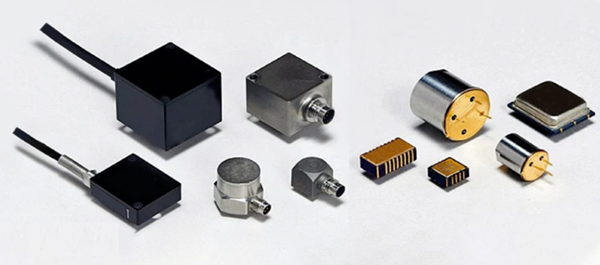
Figure 2. Accelerometers Types
Different Types of Accelerometers
Piezoelectric Accelerometers
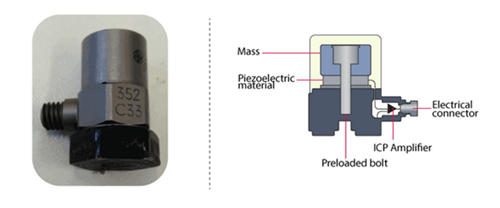
Figure 3. Piezoelectric Accelerometer and Internal Structure
A piezoelectric accelerometer works by generating an electrical signal when it experiences vibration or dynamic acceleration. It consists of a sensing crystal attached to a seismic mass. When acceleration occurs, the mass applies force to the crystal, producing an electrical signal proportional to the applied force. Piezoelectric accelerometers are highly effective for measuring vibration and shock in industrial applications.
Piezoresistive Accelerometers
Piezoresistive accelerometers operate by changing their electrical resistance when subjected to acceleration. As force is applied, the resistance of the sensing element changes, allowing acceleration to be measured. These accelerometers perform well at low-frequency and static acceleration and found in high-impact applications such as vehicle crash testing and weapons testing.
Capacitive Accelerometers
Capacitive accelerometers measure acceleration by detecting changes in capacitance between internal plates. When acceleration occurs, a diaphragm moves, changing the distance between the plates and altering capacitance. This change is measured and converted into an acceleration value. Capacitive MEMS accelerometers are applied in smartphones and consumer electronics.
Triaxial Accelerometers
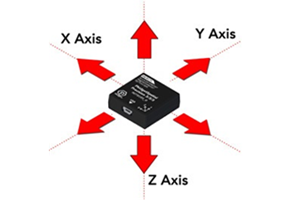
Figure 4. Triaxial Accelerometer (X, Y, Z Axes)
Triaxial accelerometers measure acceleration along three perpendicular axes (X, Y, and Z). They contain three sensing elements oriented at right angles, allowing them to capture motion and vibration in all directions. These accelerometers are perfect in structural monitoring, turbines, and high-speed machinery.
MEMS Accelerometers
MEMS (Micro-Electro-Mechanical Systems) accelerometers are very small and lightweight. They are in mobile devices, IoT products, and consumer electronics due to their low power consumption and compact size.
Applications of Accelerometers
Mobile Phones and Wearables – Help rotate screens, count steps, and detect movement.
Cars and Vehicles – Used for airbag systems, crash detection, and vehicle stability control.
Machines and Equipment – Measure vibration to find problems in motors and machines early.
Buildings and Structures – Monitor movement and vibration in bridges and buildings.
Medical Devices – Track body movement in health and fitness devices.
Robots and Automation – Help robots move, balance, and change direction.
Aerospace and Aircraft – Used for navigation and vibration monitoring.
Security Systems – Detect motion or impact in alarms and safety devices.
Accelerometer vs Gyroscope Comparison
|
Feature |
Accelerometer |
Gyroscope |
|
What it measures |
Linear movement and
acceleration |
Rotation and angular
movement |
|
Detects |
Motion, vibration,
tilt, and gravity |
Rotation speed and
direction |
|
Main output |
Acceleration (in g) |
Angular velocity
(degrees/sec or rad/sec) |
|
Gravity sensing |
Yes |
No |
|
Common uses |
Step counting, screen
rotation, vibration sensing |
Orientation tracking,
rotation control |
|
Works when stationary |
Yes (can sense
gravity) |
No (needs rotation to
give output) |
|
Typical applications |
Phones, vehicles,
machines, safety systems |
Drones, gaming
controllers, navigation systems |
|
Power consumption |
Usually low |
Usually higher than
accelerometers |
Conclusion
Accelerometers help devices sense and understand motion. By knowing how they work, their types, and how to use them correctly, you can choose the right accelerometer for your needs and get accurate results.
 ABOUT US
Customer satisfaction every time. Mutual trust and common interests.
ABOUT US
Customer satisfaction every time. Mutual trust and common interests.
function test. The highest cost-effective products and the best service is our eternal commitment.
Hot Article
- LM358 Dual Operational Amplifier Comprehensive Guide: Pinouts, Circuit Diagrams, Equivalents, Useful Examples
- Are CR2032 and CR2016 Interchangeable?
- Understanding the Differences ESP32 and ESP32-S3 Technical and Performance Analysis
- Choosing the Right Battery: A Guide to AG4, LR626, LR66, 177/376/377, SR626, and SR626SW Equivalents
- BC547 Transistor Basics: Pinout, Application Circuits, Alternative/Complementary Models
- NPN vs. PNP: What's the Difference?
- esp32 vs stm32: which microcontroller is better for you?
- What Is a MOSFET and How It Works?
- Electrical Relay Basic: Working Operation, Types and Uses
- PNP Transistors: Structure, Working Principle and Application
 Understanding Two Way Switch Wiring Uses and Safety Tips
2025-12-17
 A Beginner’s Guide to Using Flex Sensors with Arduino
2025-12-16
Frequently Asked Questions [FAQ]
1. What does an accelerometer measure in simple terms?
An accelerometer measures motion by detecting changes in speed, direction, tilt, and vibration. It helps devices understand how they are moving or positioned.
2. Can an accelerometer measure speed directly?
An accelerometer does not measure speed directly. Instead, speed can be calculated by processing acceleration data over time using software or a controller.
3. Can accelerometers detect vibration accurately?
Yes, accelerometers are widely used to measure vibration levels in machines, motors, and structures to monitor condition and performance.
4. Do accelerometers work when the device is not moving?
Yes, even when stationary, accelerometers sense gravity, which allows them to detect tilt, angle, and orientation.
5. What unit is used to measure acceleration?
Acceleration is commonly measured in g, where 1 g represents the acceleration caused by Earth’s gravity.
6. Are accelerometers affected by temperature?
Yes, temperature changes can affect sensor accuracy, which is why accelerometers have specified operating temperature ranges.
Hot Part Number
 C1608X7R1E474K080AB
 C2012X5R0J225K085AA
 GRM0225C1E4R1CDAEL
 CC0603ZRY5V6BB474
 UMK316B7474ML-T
 08051U150GAT2A
 GRM1886S1H1R1CZ01D
 T495D476K010ATE080
 TPSE106M050R0500
 APA600-PQ208
- MT47H64M8CF-25E:G
- MC9S12XA512VAL
- IS42S16160B-6TL
- SI8233AD-D-IS
- RT0402DRD072K49L
- CY8C20140-SX2I
- VLF4012AT-100MR79
- SKM150GAL128D
- MC100ELT21DR2G
- MC14040BDTR2G
- LT3971AIMSE#PBF
- T491D107K006ZT7280
- UCC3818N
- INA240A2PW
- IXFP22N65X2M
- LT1999CMS8-50F#PBF
- SN74LVC32ADR
- AD5262BRUZ20-RL7
- ATMXT1666T2-C2U
- BU20360-48L
- ICS950218AFT
- MAX1779EUE+TG104
- MAX202ECWE-T
- MAX8860EUA27
- G5LA-1A4-12V
- HN29V256AOBBP-30
- M66445M1FA
- NFP-2200-A3
- PCD8010H/E31/4
- PEAD22653AFV1QH14NAR
- 6MBP150RTM060
- S29GL032A90FAIR43
- TMR3-1211
- T6TD7XBG-0001
- CS242C001PZ-TRSV
- IBMPPCBWY-GES72914
- SDINBDG4-8G-XI1
- XFL4020-332MEC
- GMOV-14D500K