What Is a Synachronous Motor? A Simple Guide
2025-11-19
5245
Catalog
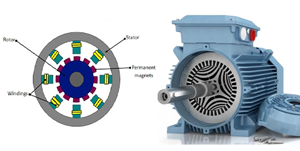
Figure 1. Synchronous Motor
What is Synchronous Motor?
A Synchronous motor is an AC motor that always turns at the same speed. This speed is fixed because the motor’s rotor turns in step with the rotating magnetic field created by the electricity in the stator.
An electric motor is a machine that changes electrical energy into movement. Motors can run on single-phase or three-phase power. In three-phase motors, the two common types are induction motors and synchronous motors.
When three-phase power flows through the stator, it creates a rotating magnetic field. If the rotor has a magnet, it will lock onto this field and turn at the exact same speed. That is why the motor is called synchronous and why its speed does not change.
Synchronous Speed Formula
Where:
NS= synchronous speed (in RPM)
f = supply frequency (in Hz)
P = number of poles
Synchronous Motor Construction
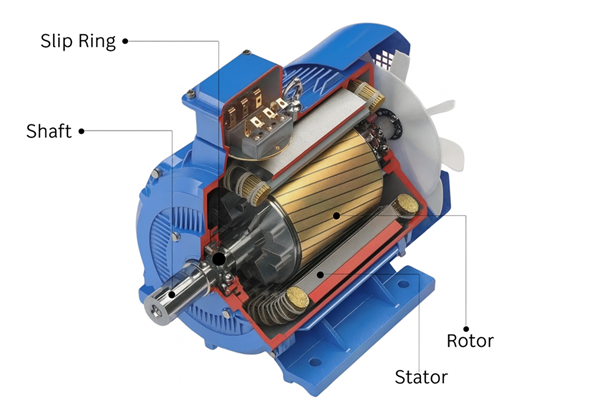
Figure 2. Construction of Synchronous Motor
As you can see in the image, a synchronous motor has two main parts: the stator on the outside and the rotor in the center. The stator is connected to a 3-phase AC supply, which creates a rotating magnetic field. The rotor, on the other side, is given a DC supply so it becomes a magnet. When the motor operates, the rotor locks onto the rotating magnetic field from the stator, and thus it turns at the same speed. This is why a synchronous motor runs at a constant, fixed speed.
How a Synchronous Motor Works
Once the rotor is spinning close to the speed of the rotating magnetic field, the magnetic forces between the stator and rotor become strong enough to “lock” them together. When this happens, the rotor starts turning at the exact same speed as the magnetic field. This is called synchronous speed.
After the rotor locks in, the motor runs at a steady and constant speed. Small changes in load do not affect this speed. The motor will keep running smoothly as long as the rotor stays locked with the rotating magnetic field. But if the load becomes too heavy, the rotor can lose its locking and the motor will stop.
During normal operation, the DC on the rotor keeps its magnet strong, and the 3-phase AC on the stator keeps the magnetic field rotating. As long as both are working, the motor will run at synchronous speed without slipping.
Features of Synchronous Motors
• Constant Speed - A synchronous motor always runs at the same speed, from no load up to full load. It does not slow down unless the load is too heavy.
• Runs at Synchronous Speed - The rotor turns at the exact speed of the rotating magnetic field, no slip.
• Doubly Excited Machine - It uses two power sources:
– 3-phase AC for the stator
– DC supply for the rotor
• Not Self-Starting - It cannot start by itself and needs a starting method like a damper winding or an external motor.
• Power Factor Control - By adjusting the DC supply, the motor can run at lagging, leading, or unity power factor.
• High Efficiency - Synchronous motors generally have good efficiency and give stable performance.
• Can Improve Power System - When over-excited, they behave like a capacitor and can improve the power factor of the entire system.
Starting Methods of Synchronous Motor
Synchronous motors cannot start on their own, so here’s the five starting methods are used to bring the rotor close to synchronous speed before it locks in with the rotating magnetic field.
First Method: Using a Damper Winding (Also called Amortisseur Winding)
In this method, special bars are placed on the rotor, similar to an induction motor. When the motor is switched on, these bars help the motor start like an induction motor. Once the motor gets close to synchronous speed, the DC supply is given to the rotor, and the motor locks into synchronous speed. This is the most common and simple starting method.
Second Method: Using a Pony Motor
A pony motor is a small separate motor used to spin the rotor. It first brings the synchronous motor close to synchronous speed. When the speeds match, the pony motor is disconnected, and the synchronous motor takes over and locks onto the rotating magnetic field. This method is used for very large motors.
Third Method: Using a Variable Frequency Drive (VFD)
A VFD slowly increases the frequency of the supply from zero to the rated frequency. As the frequency increases, the synchronous motor speeds up smoothly without needing any special starter. When the motor reaches the normal frequency, it runs at synchronous speed. This is a modern and efficient starting method.
Fourth Method: Using Slip Rings and External Resistors
In motors with slip rings, external resistors can be connected during starting to limit the current and help the rotor reach a higher speed safely. After the motor picks up speed, the resistors are removed, and the rotor is excited with DC to achieve synchronous running.
Fifth Method: Starting by Reducing the Load
Sometimes the motor can start more easily if the load on it is reduced or disconnected during starting. Once the motor reaches near synchronous speed and locks in, the load is connected again. This method is simple but only useful when the load can be controlled.
Types of Synchronous Motors
Synchronous motors are mainly divided into two basic types based on how the rotor is built and excited:
Non-Salient Pole (Cylindrical Rotor) Motor
A non-salient pole motor has a smooth, round rotor with no visible poles. Because the rotor is even and balanced, the motor can run at high speed without shaking. These motors are mostly used in places where fast and steady rotation is needed, such as in power plants.
Salient Pole Motor
A salient pole motor has a rotor with poles that stick out like small teeth. This design helps the motor produce more torque at lower speeds. These motors are used in factories for machines like pumps and compressors that need strong, steady power at slow to medium speeds.
Based on Excitation Method Types:
Wound-Field Synchronous Motor
A wound-field synchronous motor has a rotor with windings that need DC power. The DC supply makes the rotor act like a magnet. This type of motor is common in industries because the DC amount can be adjusted to control the motor’s performance and power factor.
Permanent Magnet Synchronous Motor (PMSM)
A permanent magnet synchronous motor has magnets on the rotor instead of windings. This means it does not need a DC supply or slip rings. These motors are very efficient and are used in electric cars, robots, and home appliances because they save energy and run smoothly.
Synchronous Reluctance Motor
A synchronous reluctance motor has no magnets and no windings on the rotor. The rotor is just shaped metal designed to follow the magnetic field. This makes the motor simple, strong, and low-cost. It is often used in fans, pumps, and other everyday machines.
Hysteresis Motor
A hysteresis motor has a rotor made of special magnetic material. It starts smoothly like an induction motor and then locks into synchronous speed. These motors run very quietly, so they are used in clocks, timers, and devices that need silent and stable operation.
How the Motor Improves Power Factor
A synchronous motor can improve power factor by adjusting the DC excitation on its rotor. When the rotor is given more DC current (over-excited), the motor produces a leading reactive power, which cancels out the lagging reactive power caused by inductive loads. As a result, the overall power factor of the system becomes better, often close to unity. This is why synchronous motors are sometimes not only for driving loads but also as power factor correctors in industries.
V Curve Behavior of Synchronous Motor
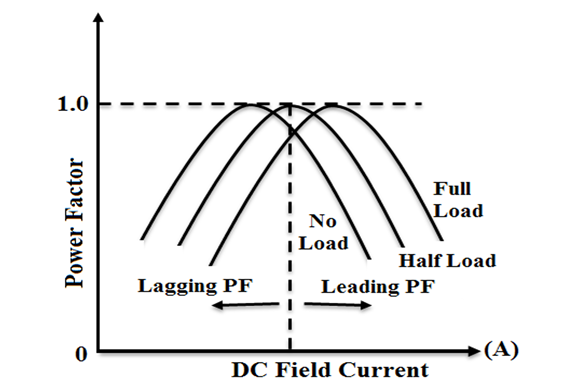
Figure 3. V Curve Behavior of Synchronous Motor
The V-curve shows how the power factor of a synchronous motor changes with DC field current. At low DC excitation, the motor operates at a lagging power factor. As we increase the DC supply, the power factor improves and reaches unity. If we keep increasing the DC field current, the motor shifts to a leading power factor. When these values are plotted, they form a curve shaped like the letter “V,” which is why it is called the V-curve.
Advantages & Disadvantages of Synchronous Motor
Advantages of Synchronous Motor:
• Runs at a constant, fixed speed.
• Can improve power factor by adjusting DC supply.
• Has high efficiency.
• Works well for low-speed, high-power jobs.
• Can act like a capacitor when over-excited.
Disadvantages of Synchronous Motor:
• Cannot start on its own.
• More complicated and expensive than induction motors.
• Needs a separate DC supply for the rotor.
• Can stop if it loses synchronism under heavy load.
• Requires more maintenance (especially slip rings and brushes).
Synchronous Motor Application
Constant-Speed Machines - Perfect for pumps, compressors, and conveyors because the motor keeps the same speed at all times.
Power Factor Improvement - When over-excited, the motor helps correct poor power factor in electrical systems, saving energy and reducing losses.
Large Blowers and Fans - Works well in ventilation and cooling systems where steady and reliable airflow is needed.
Heavy Industrial Equipment - Suitable for rolling mills, crushers, and mixers that require strong torque and stable operation.
Synchronous Condensers in Power Plants - Helps regulate voltage and maintain system stability by supplying or absorbing reactive power.
Precision Machinery - Supports machines that need accurate and constant speed, such as timers, testers, and measurement equipment.
Modern Technology (PMSM Type) - Found in electric vehicles, robots, and home appliances because permanent magnet versions are efficient and compact.
Synchronous vs Induction Motor
|
Feature |
Synchronous
Motor |
Induction
Motor |
|
Speed |
Runs at a constant,
fixed synchronous speed (no slip). |
Runs slightly below
synchronous speed (has slip). |
|
Starting |
Not self-starting;
needs extra starting methods. |
Self-starting and
easy to operate. |
|
Rotor Excitation |
Requires DC supply or
permanent magnets. |
No DC supply required;
works by induction. |
|
Power Factor |
Can be lagging,
leading, or unity; helps improve system power factor. |
Always lagging,
especially at low loads. |
|
Speed Control |
Hard to control;
speed depends on supply frequency. |
Easier to control,
especially with VFDs. |
|
Cost &
Maintenance |
More expensive and
needs more maintenance. |
Cheaper, simpler, and
low maintenance. |
|
Applications |
Best for
constant-speed jobs, heavy loads, and power factor correction. |
Common in fans,
pumps, and general-purpose machines. |
Conclusion
Synchronous motor is a motor that runs at a steady, fixed speed and can help improve the power factor of a system. Even though it needs special starting methods and a bit more care, it is very valuable in machines and industries. Knowing how it works and where it is used makes it easier to understand why it is an important type of motor.
 ABOUT US
Customer satisfaction every time. Mutual trust and common interests.
ABOUT US
Customer satisfaction every time. Mutual trust and common interests.
function test. The highest cost-effective products and the best service is our eternal commitment.
Hot Article
- LM358 Dual Operational Amplifier Comprehensive Guide: Pinouts, Circuit Diagrams, Equivalents, Useful Examples
- Are CR2032 and CR2016 Interchangeable?
- Understanding the Differences ESP32 and ESP32-S3 Technical and Performance Analysis
- Choosing the Right Battery: A Guide to AG4, LR626, LR66, 177/376/377, SR626, and SR626SW Equivalents
- BC547 Transistor Basics: Pinout, Application Circuits, Alternative/Complementary Models
- NPN vs. PNP: What's the Difference?
- esp32 vs stm32: which microcontroller is better for you?
- What Is a MOSFET and How It Works?
- Electrical Relay Basic: Working Operation, Types and Uses
- PNP Transistors: Structure, Working Principle and Application
 4-Way Light Switches: A Simple Guide to Types and Applications
2025-11-20
 Step by Step Guide to Understanding and Wiring a 3-Way Light Switch
2025-11-19
Frequently Asked Questions [FAQ]
1. Why is a synchronous motor called “synchronous”?
It is called synchronous because the rotor rotates exactly in step with the stator’s rotating magnetic field, meaning both spin at the same electrical speed.
2. What causes a synchronous motor to lose synchronism?
A motor loses synchronism when the load becomes too heavy, causing the rotor to fall out of alignment with the magnetic field and stop running properly.
3. What is the difference between synchronous speed and actual speed?
In a synchronous motor, the actual speed is exactly the same as the synchronous speed, since the rotor does not slip behind the magnetic field.
4. Can a synchronous motor operate on single-phase power?
Not normally; synchronous motors are designed for three-phase power, but special starters or converters can allow limited single-phase operation.
5. Are synchronous motors good for variable-speed applications?
They are not ideal for variable-speed use unless paired with a VFD, because their speed is normally fixed by supply frequency.
6. Do synchronous motors have slip rings?
Wound-field synchronous motors have slip rings for DC supply, while permanent magnet and brushless types do not require them.
Hot Part Number
 C1608X7R1E474K080AB
 C2012X5R0J225K085AA
 GRM0225C1E4R1CDAEL
 CC0603ZRY5V6BB474
 UMK316B7474ML-T
 08051U150GAT2A
 GRM1886S1H1R1CZ01D
 T495D476K010ATE080
 TPSE106M050R0500
 APA600-PQ208
- MT47H64M8CF-25E:G
- MC9S12XA512VAL
- IS42S16160B-6TL
- SI8233AD-D-IS
- RT0402DRD072K49L
- CY8C20140-SX2I
- VLF4012AT-100MR79
- SKM150GAL128D
- MC100ELT21DR2G
- MC14040BDTR2G
- LT3971AIMSE#PBF
- T491D107K006ZT7280
- UCC3818N
- INA240A2PW
- IXFP22N65X2M
- LT1999CMS8-50F#PBF
- SN74LVC32ADR
- AD5262BRUZ20-RL7
- ATMXT1666T2-C2U
- BU20360-48L
- ICS950218AFT
- MAX1779EUE+TG104
- MAX202ECWE-T
- MAX8860EUA27
- G5LA-1A4-12V
- HN29V256AOBBP-30
- M66445M1FA
- NFP-2200-A3
- PCD8010H/E31/4
- PEAD22653AFV1QH14NAR
- 6MBP150RTM060
- S29GL032A90FAIR43
- TMR3-1211
- T6TD7XBG-0001
- CS242C001PZ-TRSV
- IBMPPCBWY-GES72914
- SDINBDG4-8G-XI1
- XFL4020-332MEC
- GMOV-14D500K