What Is a Gyroscope Sensor and How It Works
2026-04-03
466
Catalog
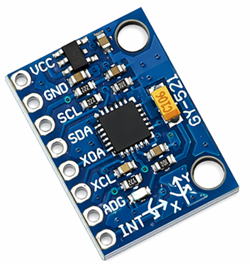
Gyroscope Sensor Basics
A gyroscope sensor measures angular velocity to determine an object’s orientation. In simple terms, it detects how fast something rotates around one or more axes.
For example, when you rotate your phone and the screen automatically switches from portrait to landscape, a gyroscope is helping make that happen.
It does not measure position directly. Instead, it tracks rotational movement, which systems use to calculate direction and orientation. This makes it useful for detecting motion that is hard to notice with basic sensors or by human perception alone.
How a Gyroscope Works?
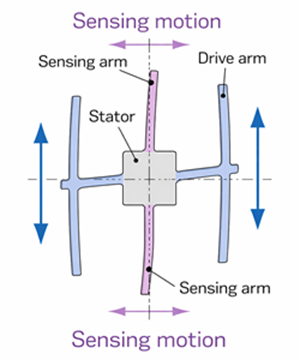
Figure 2. MEMS Gyroscope Detecting Rotation Using the Coriolis Effect
A gyroscope detects rotation using different sensing methods. Traditional gyroscopes rely on angular momentum, where a spinning object resists changes in orientation.
Modern systems use more compact technologies, such as mechanical gyroscopes that rely on spinning rotors, optical gyroscopes that use light-based detection, and MEMS gyroscopes that operate using vibrating structures.
Most devices today use MEMS gyroscopes because they are small, efficient, and suitable for portable electronics.
These sensors measure motion along different axes, including single-axis gyroscopes that detect rotation in one direction, dual-axis gyroscopes that measure movement in two directions, and three-axis gyroscopes that capture full 3D motion.
Step-by-step process
1. The internal structure vibrates continuously
2. Rotation changes the vibration pattern
3. The sensor detects electrical changes
4. The output represents angular velocity
Gyroscope vs Accelerometer
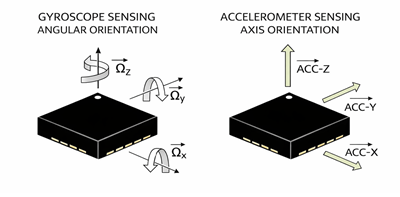
Figure 3. Gyroscope Measures Rotation, While Accelerometer Detects Linear Motion and Tilt
|
Feature |
Gyroscope |
Accelerometer |
|
What it measures |
Rotation |
Linear motion and tilt |
|
Motion type |
Angular velocity |
Linear acceleration |
|
Function |
Tracks rotation speed |
Detects movement relative to
gravity |
|
Example (smartphone) |
Screen rotation |
Tilt detection |
|
Usage together |
Often used in IMU |
Often used in IMU |
|
Purpose |
Improves rotation tracking |
Improves motion detection |
Types of Gyroscope Sensors
Gyroscopes vary by size, design, and accuracy. Some are large and highly precise for industrial use, while others are compact enough for everyday devices like smartphones.
Main Types
• Ring laser gyroscope – used in aircraft and defense systems for high accuracy
• Fiber optic gyroscope – provides precise measurement using light-based technology
• Fluid gyroscope – used in specialized applications, less common today
• Vibration gyroscope (MEMS) – widely used in modern electronics due to small size and efficiency
Ring laser and fiber optic gyroscopes are known for high precision, while vibration gyroscopes are more common in everyday devices.
Modern electronic devices mainly use vibration or MEMS gyroscopes. These can be further classified based on materials and structure, depending on the design and application.
Features of Gyroscope Sensors
Measurement range: Maximum rotation speed it can detect
Sensitivity: Ability to detect small movements
Output data rate: How fast data updates
Noise and drift: Affects accuracy over time
Power consumption: Impacts battery life
Applications of Gyroscope Sensors
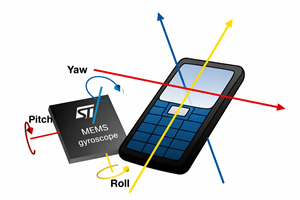
Figure 4. Gyroscope Sensor in Smartphones
Smartphones - detect screen orientation, enable motion-based controls, and improve user interaction
Drones - maintain flight stability and control during movement
Wearables - track body motion for fitness and health monitoring
Vehicles - support navigation systems and improve safety features
Robotics - help maintain balance and control movement accurately
Cameras - reduce shaking and improve image and video stabilization
Benefits and Limitations
Benefits
- High precision
- Improved stability
- Compact design
- Wide range of applications
Limitations
- Drift over time
- Sensitive to noise
- Higher cost in advanced systems
- Power consumption
Gyroscope Sensor Test Guide
Basic Testing Methods
1. Use a sensor app to monitor live data while rotating the device
2. Try a 360° video to check if the view follows movement
3. Use built-in diagnostics if available
4. Calibrate the sensor if needed
Signs of a Working Gyroscope
1. Instant response to movement
2. Smooth data changes
3. Accurate motion behavior
Conclusion
Gyroscope sensors make devices more accurate, stable, and responsive to movement. Even with some limitations, they work well when combined with other sensors. As technology improves, they continue to become smaller, smarter, and more useful in everyday devices.
 ABOUT US
Customer satisfaction every time. Mutual trust and common interests.
ABOUT US
Customer satisfaction every time. Mutual trust and common interests.
function test. The highest cost-effective products and the best service is our eternal commitment.
Hot Article
- LM358 Dual Operational Amplifier Comprehensive Guide: Pinouts, Circuit Diagrams, Equivalents, Useful Examples
- Are CR2032 and CR2016 Interchangeable?
- Understanding the Differences ESP32 and ESP32-S3 Technical and Performance Analysis
- Choosing the Right Battery: A Guide to AG4, LR626, LR66, 177/376/377, SR626, and SR626SW Equivalents
- NPN vs. PNP: What's the Difference?
- esp32 vs stm32: which microcontroller is better for you?
- BC547 Transistor Basics: Pinout, Application Circuits, Alternative/Complementary Models
- What Is a MOSFET and How It Works?
- Electrical Relay Basic: Working Operation, Types and Uses
- PNP Transistors: Structure, Working Principle and Application
 How Reflector Antennas Send and Receive Signals
2026-04-03
 Understanding Hay’s Bridge: Construction, Theory, and Benefits
2026-04-03
Frequently Asked Questions [FAQ]
1. How do I know if my phone has a gyroscope sensor?
You can check your phone’s specifications online or use a sensor test app to see if gyroscope data is available.
2. Can a device work properly without a gyroscope sensor?
Yes, but features like screen rotation, AR apps, and motion-based controls may be less accurate or limited.
3. Why is a gyroscope important for gaming?
It allows motion-based controls, making games more interactive by responding to device movement instead of just touch.
4. What is gyroscope drift and how can it be fixed?
Drift is a gradual error in measurement over time. It can be reduced through calibration or by combining with other sensors.
5. How accurate are gyroscope sensors in smartphones?
They are fairly accurate for everyday use, but not as precise as high-end industrial or navigation systems.
6. Do all smartphones have a gyroscope sensor?
No, some budget phones may not include it and instead rely on other sensors for basic motion detection.
Hot Part Number
 C3225X8R1E225K200AA
 CGJ3E2X7R1E683K080AA
 GRM1555C1H300GA01D
 CL05A224MP5NNNC
- CL10C2R2BB8NNNL
 12067A561GAT2A
 1060-16-0144
 M24308/4-1F
 NFM3DCC222R1H3L
 CY22050FZXC
- ATXMEGA128B1-AUR
- W29N02GVSIAA
- VI-203-IX
- MAX530BCAG
- 25LC640AT-I/ST
- IR2302SPBF
- FF650R17IE4D_B2
- SKM50GB17V
- AD8132ARZ
- XC7A35T-1CPG236I
- UCC38C43DGKRG4
- LT8361HMSE#PBF
- LT1940EFE#PBF
- ADM8695ARW
- T491A475K016AT4860
- LM10000SD/NOPB
- ADS58C20IPFPR
- SN74AHCT32PWR
- MSC1210Y5
- A20
- AD5561JBCZ
- ALVCH16952
- AM486DX2-66V16BYC
- BSC032NE2SXT
- FSTU6800
- PBL38620/2R2
- PMC8518TS
- SI3017-KSR
- SY100EP14UK
- RTL8102E-VB-GR
- APW7145KAI-TRL
- CM6800T+X
- DE56VT167DE5ALC
- EUA2035E
- SM324QF-BC
- TRF6150PAP
- SPC5744BK1AVKU2
- KB25AAEL3E04G-R
- TMP93CS32FG6KG5