Squirrel Cage Induction Motor: Overview, How It Works, Applications
2025-11-20
8179
Catalog
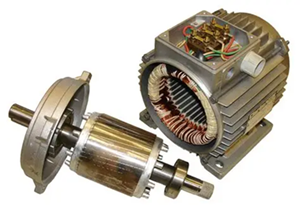
Figure 1. Squirrel Cage Induction Motor
What is a Squirrel Cage Induction Motor?
A Squirrel Cage Induction Motor is a type of electric motor that is common in machines, factories, and home appliances.
It is called a “squirrel cage” motor because the rotor inside it has metal bars arranged in a circle, and this shape looks like the running wheel used by squirrels.
When electricity flows into the stator (the outer part of the motor), it creates a rotating magnetic field. This magnetic field passes over the rotor bars and causes an electric current to form inside the rotor. The current in the rotor creates another magnetic field, and the two magnetic fields push against each other. This push is what makes the rotor spin.
The rotor is strong and simple, made of stacked steel sheets with aluminum or copper bars. Because of this simple design, squirrel cage motors are very reliable, need little maintenance, and can start on their own.
How a Squirrel Cage Induction Motor Works
A squirrel cage induction motor works by using a rotating magnetic field to make its rotor spin. When three-phase AC power is supplied to the stator, it creates a magnetic field that rotates inside the motor. This rotating field passes over the rotor bars, which are arranged like a squirrel cage, and it induces an electric current in them. The current in the rotor creates its own magnetic field, and the two magnetic fields push against each other. This push produces torque, which makes the rotor turn and run the machine. The rotor always spins slightly slower than the rotating magnetic field, and this small speed difference is what keeps current flowing in the rotor and allows the motor to work.
Internal Structure of a Squirrel Cage Motor

Figure 2. Construction of a Squirrel Cage Motor
A squirrel cage induction motor is made up of a stator, rotor, fan, and bearings. The stator is the stationary part, containing a three-phase winding placed 120° apart mechanically inside a laminated iron core. These laminations reduce losses and provide a smooth path for magnetic flux. When three-phase AC is applied, the stator produces a rotating magnetic field. Inside it sits the rotor, which is the rotating part of the motor. The rotor has a laminated core with aluminum or copper bars embedded in it, and these bars are short-circuited at both ends by end rings, forming the familiar “squirrel cage” structure.
The rotor bars are often skewed to reduce noise and prevent cogging, helping the motor start smoothly. A fan is mounted on the rotor shaft to provide cooling and keep the motor temperature within safe limits during operation. Bearings support the rotor shaft and allow it to rotate smoothly with minimal friction.
Equivalent Circuit of Squirrel Cage Induction Motor
The equivalent circuit of a squirrel cage induction motor is a simple electrical model that helps us understand how the motor works without opening it. In this model, the stator is shown using a resistance and a reactance to represent the losses and the magnetic effects in its windings. A magnetizing branch is added to show the current needed to create the rotating magnetic field. The rotor is also shown as a resistance and reactance, but these values change with slip because the rotor only works when it turns a little slower than the magnetic field. By using this circuit, we can easily calculate things like motor current, torque, power, and efficiency.
Performance Characteristics of Squirrel Cage Induction Motor
• Motor produces good starting torque, reaches a maximum torque at a certain speed, and then runs smoothly at a speed slightly lower than synchronous speed.
• Slip is the difference between the speed of the magnetic field and the rotor speed. It is low at no load and increases as the load on the motor increases.
• Motor operates with good efficiency, especially when running at or near full load.
• Power factor is low at light load but improves as the motor takes on more load.
• Motor keeps a fairly constant speed even when the load changes, making it reliable for many applications.
• The motor draws a high starting current for a short time when switched on, then settles to a lower operating current as it reaches running speed.
• It runs smoothly with little vibration and is known for strong, stable operation.
Starting Methods of Squirrel Cage Induction Motor
A squirrel cage induction motor can start in different ways depending on how much starting current and smoothness we need.
In a Direct-On-Line (DOL) start, the motor is connected directly to full voltage, so it starts quickly but draws a very high current; this is usually used for small motors. In a Star-Delta start, the motor first starts in a star connection, which gives it lower voltage and lower starting current, and then switches to delta for normal operation; this reduces the strong current at startup but also reduces starting torque. An Autotransformer start uses a transformer to give the motor reduced voltage at first, and then switches to full voltage once the motor speeds up; this method gives better control and is used for bigger motors. A Soft Starter slowly increases the voltage when the motor starts, allowing a smooth, gentle acceleration that reduces stress on the machine; it’s usually used for pumps and fans. A Variable Frequency Drive (VFD) is the most advanced method, it controls both voltage and frequency, letting the motor start very smoothly, use low starting current, and even change its speed during operation; this method is energy-efficient and offers the best control.
Squirrel Cage Induction Motor Applications
Here are the applications of a squirrel cage induction motor:
Pumps – Powering water pumps, irrigation units, and industrial pumping systems with smooth and reliable operation.
Fans and Blowers – Driving ventilation systems, cooling equipment, and HVAC units to maintain steady airflow.
Compressors – Operating air compressors in workshops and industries where continuous performance is needed.
Conveyors – Moving materials in factories while keeping a stable and consistent speed.
Mixers and Grinders – Running food-processing machines, chemical mixers, and workshop grinders at constant speeds.
Machine Tools – Driving drills, lathes, milling machines, and similar tools that require dependable motion.
HVAC Systems – Powering air conditioners, chillers, and ventilation equipment for long-term, reliable service.
Household Appliances – Found in washing machines, refrigerators, and small home devices due to their simplicity and efficiency.
Agricultural Equipment – Driving grain mills, threshers, and irrigation machinery in farming applications.
Elevators and Lifts – Providing smooth and steady movement for lifting systems.
Mining and Construction Machinery – Powering crushers, hoists, and heavy-duty equipment in demanding environments.
Advantages & Disadvantages of Squirrel Cage Induction Motor
Advantages of Squirrel Cage Induction Motor:
• Fewer parts make it easy to build and very reliable.
• No brushes or slip rings, so it requires very little upkeep.
• Strong construction allows it to handle tough working conditions.
• Cheaper to manufacture and operate compared to other motor types.
• Does not need extra equipment to start; it starts automatically when powered.
• Works efficiently, especially at full load.
• Runs at almost constant speed even when the load changes.
• Easy to find in many power ratings and designs.
Disadvantages of Squirrel Cage Induction Motor:
• Draws a large amount of current when starting, which may require special starters for bigger motors.
• Hard to adjust speed without additional devices like VFDs.
• Not ideal for loads that need very high torque at startup unless specially designed rotor bars are used.
• Has a low power factor when running with little load.
• Always runs slightly slower due to slip.
• Needs extra electronics to change speed efficiently.
Performance Types of Squirrel Cage Induction Motors
NEMA (National Electrical Manufacturers Association) classifies squirrel cage induction motors into different performance types based on how they behave when starting and running. These classes describe things like starting torque, starting current, and slip, helping you choose the right motor for the right job. Classes A–D are the most common, while E and F are special low-torque designs.
Class A – Standard Performance
- Normal starting torque
- Normal starting current
- Low slip
- Pullout torque around 200–300% of full-load torque
- Good for applications where high starting current is acceptable
Class B – Most Common Design
- Normal starting torque
- Lower starting current than Class A
- Low slip (less than 5%)
- Slightly lower pullout torque due to higher rotor reactance
- Popular general-purpose motor used in most industries
Class C – High Starting Torque
- High starting torque
- Low starting current
- Low slip
- Often uses double-cage rotors
- Ideal for loads needing strong initial power like pumps, compressors, and conveyors
Class D – Very High Starting Torque
- Very high starting torque (275% or more of rated torque)
- Low starting current
- High slip (7–11% or higher)
- Rotor has high resistance
- Good for heavy, hard-to-start loads like crushers and punch presses
Class E – Very Low Starting Torque
- Very low starting torque
- Normal starting current
- Low slip
- Not suitable for heavy loads
- Sometimes paired with compensators or resistance starters
Class F – Low Starting Torque
- Starting torque about 1.25 × full-load torque
- Low starting current
- Normal slip
- Used for light-load applications where high starting torque is not required
Squirrel Cage vs. Slip Ring Induction Motor
Below is a comparison table between squirrel cage and wound rotor (slip ring) motors:

Figure 3. Squirrel Cage vs. Slip Ring Induction Motor
|
Feature |
Squirrel
Cage Induction Motor |
Slip
Ring Induction Motor |
|
Rotor Construction |
Rotor has
aluminum/copper bars short-circuited by end rings (squirrel-cage shape). |
Rotor has 3-phase
windings connected to slip rings and external resistors. |
|
Starting Torque |
Normal to moderate. |
High starting torque
(adjustable using external resistance). |
|
Starting Current |
High starting
current. |
Low starting current
due to added rotor resistance. |
|
Speed Control |
Limited unless using
a VFD. |
Easier speed control
by changing rotor resistance. |
|
Maintenance |
Very low; no brushes
or slip rings. |
Higher; brushes and
slip rings need regular care. |
|
Cost |
Lower cost; simple
construction. |
Higher cost; more
complex system. |
|
Durability |
Very robust and
long-lasting. |
Less robust due to
slip rings and brushes. |
|
Applications |
Pumps, fans,
compressors, conveyors, household appliances. |
Cranes, hoists,
elevators, mills, heavy-duty machinery. |
Conclusion
Squirrel cage induction motors are known since they are simple, strong, and easy to maintain. They work well in many applications and offer good performance for our every-day and industrial needs. Understanding their features and types makes it easier to choose the right motor for your project.
 ABOUT US
Customer satisfaction every time. Mutual trust and common interests.
ABOUT US
Customer satisfaction every time. Mutual trust and common interests.
function test. The highest cost-effective products and the best service is our eternal commitment.
Hot Article
- LM358 Dual Operational Amplifier Comprehensive Guide: Pinouts, Circuit Diagrams, Equivalents, Useful Examples
- Are CR2032 and CR2016 Interchangeable?
- Understanding the Differences ESP32 and ESP32-S3 Technical and Performance Analysis
- BC547 Transistor Basics: Pinout, Application Circuits, Alternative/Complementary Models
- Choosing the Right Battery: A Guide to AG4, LR626, LR66, 177/376/377, SR626, and SR626SW Equivalents
- NPN vs. PNP: What's the Difference?
- esp32 vs stm32: which microcontroller is better for you?
- What Is a MOSFET and How It Works?
- Electrical Relay Basic: Working Operation, Types and Uses
- PNP Transistors: Structure, Working Principle and Application
 How Your Thermostat Works and What Each Wire Does
2025-11-21
 4-Way Light Switches: A Simple Guide to Types and Applications
2025-11-20
Frequently Asked Questions [FAQ]
1. Why is a squirrel cage induction motor called an induction motor?
It is called an induction motor because the rotor does not receive power directly. Instead, current is induced into the rotor by the rotating magnetic field from the stator, which then creates torque.
2. What causes slipping in a squirrel cage induction motor?
Slip occurs because the rotor must rotate slightly slower than the magnetic field to produce the relative motion needed to generate current. If there were no slip, no torque would be produced.
3. What happens if the slip is zero in an induction motor?
If the slip is zero then the rotor will move at the same speed as the magnetic field. This stops the induction of current in the rotor, meaning the motor can no longer produce torque, causing it to slow down immediately.
4. How long can a squirrel cage induction motor operate?
These motors can last 10–20 years or even longer with proper care. Their simple and brushless construction makes them durable and resistant to wear.
5. Can a squirrel cage induction motor produce high starting torque?
Standard designs provide moderate starting torque, but special versions such as deep rod or double cage rotors provide higher torque effectively for heavy starting applications.
6. Why does the squirrel cage motor vibrate?
Vibration can be caused by shaft misalignment, unbalanced loads, damaged bearings, bent shafts, or uneven rotor bars. Regular maintenance helps prevent these problems.
Hot Part Number
 CGA9N3X7S2A106K230KB
 C3216X7S0G476M160AB
 CL05B562KA5NNNC
 CGA3E3X8R2A333M080AD
 1206PC473KAT2A
- CL10C151GB8NNWC
 GCM1555C1H391JA16D
 GRM1885C2A8R0DA01J
 GQM2195C1H470GB01D
 GRM0336R1E1R2CD01D
- T510E108M004AS4115
- BZT52C5V1T-7
- 843252AGLFT
- RTC-72421B
- LAN9514-JZX-TR
- XRT86VX38IB256-F
- VI-JT3-EW
- EP1S25F1020C5
- S912B32E4VFUE8R
- V48C12C150B
- V300A48M500BL
- 6MBI35S-140-50
- NCV2903DMR2G
- CAT3200ZI-GT3
- ADG721BRMZ-REEL
- T491D106M035AT7128
- F6KA2G605A4LA-Z
- AD9226ARSZRL
- ADS8341EB
- LC898212XD-SH
- TPS2541RTET
- LP2953IM-3.3
- ADF4106BRUZRL
- ATAR862N-087-TNQ38
- BCM5751MKFBG
- BQ20881DBTR
- EL2120CS
- K4B4G1646E-BCK0
- M5M5V108DKV-70HI
- MC14051BCP
- MPC993FA
- PI3HDMI2410-AFFE
- XCS20XL5TQ144C
- APA2621RI-TRG
- DS24B33S+T&R
- IDT71V321L25TFI
- RTL8366S-VS-GR
- SKKT215/16E
- EXO-3C16MHz