Frequently Asked Questions
What capacitance value does the CL32Y475KCVZW6E provide that supports effective filtering in compact 1210 footprint circuits?
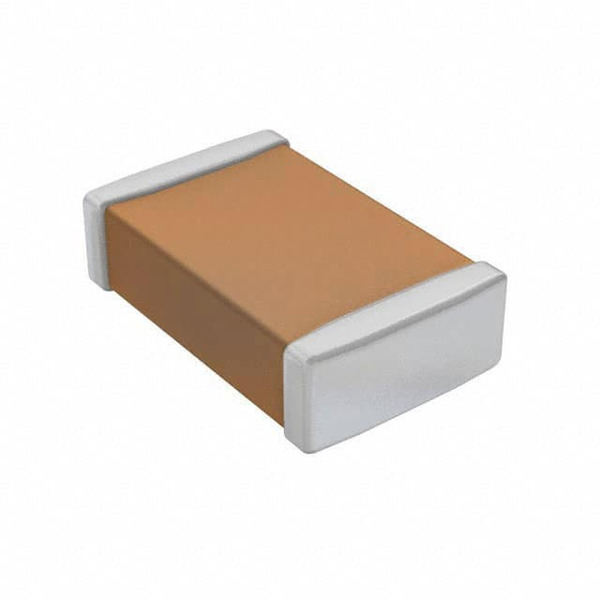
The CL32Y475KCVZW6E provides a 4.7 µF capacitance with ±10% tolerance in a 1210 package, allowing stable voltage smoothing in space-limited designs where the 3.20mm x 2.50mm footprint minimizes parasitic inductance while still handling typical ripple currents without excessive self-resonance shift.
How does the 100V voltage rating of the CL32Y475KCVZW6E factor into derating decisions for power rails with occasional transients?
The CL32Y475KCVZW6E maintains its X7S dielectric integrity when operated at 100V, enabling conservative derating (typically 80% of rated voltage) in designs with surge margins, thereby reducing leakage current risk and preserving long-term capacitance stability under varying load conditions.
In what manner does the X7S temperature coefficient of the CL32Y475KCVZW6E influence capacitance behavior from -55°C to 125°C?
The X7S temperature coefficient of the CL32Y475KCVZW6E limits capacitance change to within the ±10% tolerance band across its full operating temperature window, preventing excessive detuning in temperature-variable circuits such as those in embedded controllers where thermal cycling could otherwise degrade filter cutoff frequency.
Why is the soft termination of the CL32Y475KCVZW6E advantageous in boardflex sensitive assemblies?
The soft termination of the CL32Y475KCVZW6E minimizes solder joint stress when PCBs undergo repeated flexing or bending, which is especially useful in compact consumer or industrial enclosures where standard terminations might open-circuit after thousands of flex cycles.
How do the package dimensions of the CL32Y475KCVZW6E affect reflow soldering and board layout density?
The 1210 package of the CL32Y475KCVZW6E with 0.126" length by 0.098" width and 0.110" maximum thickness enables high component density on double-sided boards while providing adequate solder paste volume for reliable wetting without bridging in automated placement.
How does the CL32Y475KCVZW6E compare to the CL32B475KCVZW6E regarding termination for applications involving mechanical stress?
Both the CL32Y475KCVZW6E and the CL32B475KCVZW6E share identical 4.7 µF, 100V, X7S characteristics, yet the Y-series soft termination on the CL32Y475KCVZW6E delivers better resistance to board flex-induced fatigue compared to the B variant, reducing failure rates in vibration-prone environments.
Is the CL32Y475KCVZW6E suitable for designs requiring 4.7 µF capacitance in the smallest practical footprint?
The CL32Y475KCVZW6E delivers 4.7 µF in a 1210 package that occupies less board area than equivalent 0805 or 1206 parts while maintaining the same voltage and temperature ratings, making it preferable when total component volume must be minimized without sacrificing decoupling effectiveness.
How does the -55°C to 125°C operating temperature range of the CL32Y475KCVZW6E support performance in industrial control systems?
The -55°C to 125°C operating temperature range of the CL32Y475KCVZW6E keeps capacitance variation minimal under wide thermal swings typical of factory automation equipment, avoiding the need for additional thermal compensation in systems that experience seasonal or localized heating.
What considerations arise when migrating from the C3225X7S2A475K200AE to the CL32Y475KCVZW6E in existing 1210 layouts?
Migrating to the CL32Y475KCVZW6E from the C3225X7S2A475K200AE maintains identical capacitance, voltage, and temperature coefficient values but adds Samsung soft termination, which improves mechanical reliability in flex-heavy applications while preserving the same 3.2 mm x 2.5 mm footprint and reflow profile.
How does the CL32Y475KCVZW6E compare to the HMJ325KC7475KMHPE for footprint and termination compatibility?
The CL32Y475KCVZW6E and HMJ325KC7475KMHPE share matching 1210 dimensions and 4.7 µF 100V X7S ratings, yet the CL32Y475KCVZW6E's soft termination provides superior solder joint durability under board movement compared to the HMJ325KC7475KMHPE, reducing risk of intermittent opens in dynamic assemblies.
Does the CL32Y475KCVZW6E maintain stable performance in consumer electronics subjected to varying load currents?
The CL32Y475KCVZW6E's combination of 100V rating and X7S stability keeps ripple attenuation consistent even as load currents fluctuate in portable devices, helping limit voltage droop on the supply rail without exceeding temperature or voltage derating limits during peak operation.
In what manufacturing scenarios does the MSL 1 rating of the CL32Y475KCVZW6E simplify assembly procedures?
The MSL 1 rating of the CL32Y475KCVZW6E allows standard room-temperature handling and reflow without moisture baking, streamlining high-volume production lines where consistent shelf life and rapid assembly throughput are priorities while still delivering reliable performance after soldering.