Frequently Asked Questions
What design constraints should I consider when selecting the RLR05C2401GPB14 for a precision analog circuit requiring 0.1% measurement accuracy?
The RLR05C2401GPB14 offers ±2% tolerance and a temperature coefficient of ±100ppm/°C, which together create cumulative drift across operating temperature ranges. In a -65°C to 150°C environment, the 2.4 kOhm resistor can shift by approximately ±240 ohms from temperature alone, plus the initial ±2% manufacturing tolerance (±48 ohms). For circuits demanding 0.1% accuracy, the RLR05C2401GPB14 is suitable primarily as a non-critical bias or pull-down element rather than a precision reference divider. If the application requires better stability, consider adding external trimming or selecting resistor networks with tighter matching.
How does the 1/8W power rating of the RLR05C2401GPB14 affect circuit design when used in series with signal conditioning paths?
The 0.125W rating of the RLR05C2401GPB14 establishes a maximum continuous dissipation limit. At 2.4 kOhms, this translates to approximately 17.3mA maximum current before thermal stress accumulates. In signal conditioning circuits with AC coupling or transient-heavy loads, the RLR05C2401GPB14 can handle momentary pulses exceeding 17.3mA if duty cycle is low; however, sustained DC biasing near this threshold will cause resistor body temperature to rise, accelerating aging and drift. For high-impedance sensor interfaces (>10MΩ) or precision measurement paths where the RLR05C2401GPB14 carries only microamps, the power rating is not limiting.
Why is the RLR05C2401GPB14 specified as military-grade with moisture-resistant construction, and what reliability advantage does this provide over commercial resistors?
The RLR05C2401GPB14 complies with MIL-PRF-39017/05, a qualification standard requiring controlled manufacturing, destructive testing, and a published failure rate of 0.1% per 1,000 hours. The moisture-resistant metal film construction and weldable terminations enable the RLR05C2401GPB14 to maintain performance in humid, vibration-prone, or thermally cycled environments—conditions common in aerospace, defense, and industrial control systems. Commercial resistors typically carry failure rates 10–100 times higher and lack environmental qualification documentation. If your design requires documented reliability metrics or must survive MIL-STD environmental testing, the RLR05C2401GPB14 is necessary; for benign indoor consumer applications, commercial alternatives offer cost savings without reliability penalty.
Is the RLR05C2401GPB14 suitable for direct wire-bonding or soldering in hybrid integrated circuits, and what precautions apply?
The RLR05C2401GPB14 features weldable terminations specifically designed for hybrid and thick-film applications where direct wire bonding or ultrasonic welding replaces traditional solder joints. The axial leads can be attached to hybrid substrates using thermocompression bonding or laser welding without degrading the metal film element. However, the RLR05C2401GPB14 is not optimized for reflow soldering in high-volume SMT environments; its through-hole axial form and lead geometry suit hand assembly, wave soldering, or manual placement in low-density circuits. If your manufacturing process involves pick-and-place and reflow, surface-mount metal film alternatives (0603, 0805) may offer better throughput despite losing the weldability feature of the RLR05C2401GPB14.
How does the axial package geometry of the RLR05C2401GPB14 impact thermal management in potted or enclosed circuit modules?
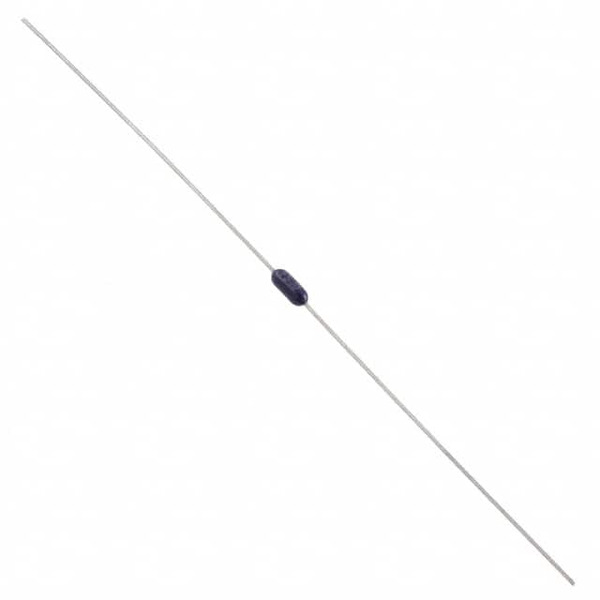
The RLR05C2401GPB14 measures 1.68mm diameter × 3.81mm length, presenting a small thermal footprint but a high surface-area-to-mass ratio that aids convective cooling. In open-air circuits with natural or forced convection, the RLR05C2401GPB14 dissipates the full 0.125W without exceeding 70°C above ambient. In potted modules or conformal-coated assemblies, thermal coupling to the encapsulant reduces convective cooling, effectively lowering the safe power level of the RLR05C2401GPB14 to 60–80mW. For potted designs, calculate power dissipation conservatively and verify with thermal analysis; alternatively, select lower-dissipation values or add thermal spreading (copper traces, heat sinks) around the RLR05C2401GPB14 to maintain margin.
What is the root cause of the ±100ppm/°C temperature coefficient in the RLR05C2401GPB14, and how does this compare to thin-film or wirewound alternatives?
Metal film resistors, including the RLR05C2401GPB14, exhibit temperature coefficient primarily due to thermally induced changes in the film's electrical properties and slight dimensional expansion of the ceramic substrate. The ±100ppm/°C figure is typical for general-purpose metal film; precision wirewound resistors achieve ±25ppm/°C by using special alloys and post-annealing, while thin-film hybrid resistors reach ±10ppm/°C or better through laser trimming and substrate selection. The RLR05C2401GPB14 is not a precision reference component. For applications requiring <±50ppm/°C stability (precision instrumentation, frequency references), thin-film or trimmed wirewound alternatives are necessary; the RLR05C2401GPB14 is adequate for bias networks, signal routing, and gain-setting in systems where absolute accuracy matters less than repeatable behavior across operating temperature.
Can the RLR05C2401GPB14 be used as a termination resistor in high-frequency transmission line circuits, or are parasitic effects limiting?
The RLR05C2401GPB14 is fundamentally unsuitable for transmission line or impedance-controlled applications above a few megahertz. Axial resistors exhibit distributed inductance (typically 5–15nH for a 3.81mm lead geometry) and capacitance to ground that introduce frequency-dependent impedance variations. At frequencies above 10MHz, the RLR05C2401GPB14's nominal 2.4 kOhm resistance becomes masked by inductive reactance, and reflections occur even when DC resistance is correctly matched. For transmission line termination, video driver pulldowns, or RF matching networks, surface-mount chip resistors with minimal lead length (<0.5nH parasitic inductance) are essential. The RLR05C2401GPB14 is appropriate for baseband analog circuits, audio conditioning, and power supply bias applications where bandwidth does not exceed 1MHz.
What is the expected lifespan of the RLR05C2401GPB14 in continuous operation at elevated temperature, and how does failure rate interact with thermal stress?
The RLR05C2401GPB14 carries a published failure rate of 0.1% per 1,000 hours under MIL-PRF-39017/05 qualification, typically measured at 70°C with 90% of rated power applied. At maximum temperature (150°C) and maximum power (0.125W continuous), the failure rate rises due to accelerated film degradation and lead corrosion. Using a conservative Arrhenius acceleration model, the failure rate approximately doubles for every 25°C rise above the qualification baseline, suggesting the RLR05C2401GPB14 could reach 0.3–0.5% per 1,000 hours at 150°C under full load. For mission-critical applications, the RLR05C2401GPB14 should operate at <50% of rated power and <100°C ambient to maintain the published 0.1% failure rate. If the circuit is thermally constrained and must operate near 150°C, derating or redundant selection is prudent.
How should the RLR05C2401GPB14 be specified in a reliability prediction model, and are alternative failure rate models more appropriate than MIL-HDBK-217?
The RLR05C2401GPB14's published failure rate of 0.1% per 1,000 hours derives from MIL-PRF-39017/05 qualification data, which is often used directly in MIL-HDBK-217F reliability modeling rather than derived from generic equations. However, MIL-HDBK-217F predicts higher failure rates for metal film resistors under environmental stress, leading to conservative estimates. Modern reliability predictions (Telcordia, Simic, or supplier-provided FIT rates) often yield lower values because they account for improvements in manufacturing and materials since the 1990s. For the RLR05C2401GPB14, if manufacturer data sheets cite 0.1% per 1,000 hours as the baseline, use this value directly unless the application involves temperature cycling, corrosive atmospheres, or vibration—conditions that accelerate failure modes not captured in static thermal predictions. Consider obtaining accelerated life test data or supplier failure history for the RLR05C2401GPB14 if the design targets >10-year mission life.
Is the RLR05C2401GPB14 suitable as a replacement for older film resistor part numbers in legacy military or aerospace systems requiring design validation?
The RLR05C2401GPB14 belongs to the RLR05 series, a modern interpretation of legacy military resistor specifications. If the original design called for an RLR05 (any tolerance or power rating), the RLR05C2401GPB14 is a drop-in replacement provided the 2.4 kOhm value and ±2% tolerance match the original requirement. However, if the legacy system specified an RLR02 or RLR10 series (different form factors or ratings), the RLR05C2401GPB14 may not be interchangeable without re-qualification. Mechanical fit (lead diameter, length, spacing) and electrical performance (temperature coefficient, aging characteristics) must be verified before substitution. For aerospace or military platforms, formal change authorization and re-testing of the RLR05C2401GPB14 in the actual circuit environment may be mandated by design control procedures.
What moisture and corrosion protection mechanisms in the RLR05C2401GPB14 differentiate it from standard industrial-grade resistors?
The RLR05C2401GPB14 features a moisture-resistant construction achieved through conformal coating, sealed end caps, and careful lead finish selection to prevent corrosion of the terminations. The metal film element itself is protected from atmospheric ingress by the ceramic substrate and coating layers, preventing drift due to humidity cycling. Standard industrial resistors often lack this encapsulation, allowing moisture to penetrate the film and cause high-frequency noise, erratic leakage current, or intermittent connection issues—particularly in salt-spray or high-humidity environments. The weldable terminations of the RLR05C2401GPB14 also resist tarnishing and oxidation, maintaining low contact resistance over decades in storage or field deployment. For applications in maritime, petrochemical, or outdoor installations where humidity and salt spray are present, the RLR05C2401GPB14's moisture resistance eliminates the need for secondary potting or protective enclosures around individual components.
How do the ±2% tolerance and metal film construction of the RLR05C2401GPB14 compare to carbon film or composite resistor alternatives in terms of long-term stability?
Metal film resistors like the RLR05C2401GPB14 exhibit superior long-term stability compared to carbon film or carbon composition alternatives. The RLR05C2401GPB14's metal film exhibits <0.5% change per year under normal storage or operating conditions, whereas carbon film resistors drift 1–2% per year and carbon composition resistors can shift 5–10% over a decade due to moisture absorption and chemical aging in the binder matrix. The initial ±2% tolerance of the RLR05C2401GPB14 is tighter than typical carbon film (±5–10%), meaning the RLR05C2401GPB14 provides better as-delivered accuracy and more predictable long-term behavior. For circuits designed for 5–10 year operational life with minimal recalibration (such as sensor bridges, reference networks, or analog filtering), the RLR05C2401GPB14 eliminates the creep and drift problems endemic to carbon-based resistors, justifying the higher cost.
Are there significant performance differences between the RLR05C2401GPB14 and commercial metal film resistors rated for -25°C to 125°C, and how should this affect component selection?
The RLR05C2401GPB14 extends operating range to -65°C and 150°C, a span of 215°C compared to the 150°C span typical for commercial parts. This wider range requires tighter manufacturing controls and more robust encapsulation to prevent thermomechanical failure of the film and lead bonds. The RLR05C2401GPB14 maintains the same ±100ppm/°C temperature coefficient across its full range, whereas commercial resistors sometimes exhibit non-linearity at temperature extremes. The RLR05C2401GPB14's military qualification ensures it survives thermal shock (rapid transitions between extremes) without cracking the substrate or delaminating the film. If the application is genuinely constrained to -25°C to 125°C and does not require military documentation, commercial metal film resistors (cost typically 30–50% lower) perform adequately; however, if operation outside -25°C to 125°C is possible or if thermal cycling is frequent, the RLR05C2401GPB14's extended range and qualification provide risk mitigation.
What is the practical difference between the RLR05C2401GPB14 and a precision thin-film hybrid resistor array in terms of matching tolerance and drift symmetry for sensor signal conditioning?
The RLR05C2401GPB14 is a discrete component with independent manufacturing tolerances; when multiple RLR05C2401GPB14 units are used in a ratiometric circuit (such as a bridge excitation divider), each resistor experiences slightly different aging and temperature drift, introducing cumulative errors. Thin-film hybrid resistor arrays (e.g., 4-resistor networks on a single substrate) achieve matching tolerances of ±0.1% and ratio drifts <±25ppm/°C because all elements are deposited simultaneously on the same substrate, ensuring material uniformity and thermal coupling. For sensor signal conditioning where the absolute value of one resistor matters less than the matching between multiple resistors, a thin-film array is superior; the RLR05C2401GPB14 alone is sufficient if the circuit relies on the resistor's absolute value or if ratiometric performance can tolerate the natural drift asymmetry between discrete components. Cost and circuit board real estate typically favor discrete RLR05C2401GPB14 units unless matching better than ±0.5% is non-negotiable.
Does the RoHS non-compliance of the RLR05C2401GPB14 restrict its use in commercial consumer electronics, and what alternatives exist?
The RLR05C2401GPB14 is RoHS non-compliant, likely due to its military-grade lead finish or manufacturing process that does not exclude lead or other restricted substances. Most commercial consumer electronics sold in the EU, North America, and Asia require RoHS compliance, meaning the RLR05C2401GPB14 cannot be directly integrated into end-use consumer products without a regulatory exemption (which is rarely granted for passive components). However, the RLR05C2401GPB14 remains acceptable for military, aerospace, and medical device applications where RoHS exemptions are standard, as well as for OEM use in industrial control systems not destined for retail consumer sales. If RoHS compliance is mandatory, equivalent RoHS-compliant metal film resistors (typically commercial-grade, not military-qualified) are available from Vishay and competitors; these sacrifice the military qualification and extended temperature range of the RLR05C2401GPB14 but meet regulatory requirements for consumer deployment.