Frequently Asked Questions
How does the 17V reverse standoff voltage of the SMCJ17A-QH allow it to remain in a high-impedance state during normal circuit operation while preparing for transient events?
The 17V reverse standoff voltage of the SMCJ17A-QH maintains low leakage current below the activation threshold in steady-state conditions, keeping the device off until the voltage exceeds the 18.9V minimum breakdown point and triggers clamping to 27.6V under a 54.4A peak pulse current, which optimizes protection in sensitive low-voltage paths without introducing continuous power loss.
What does the minimum breakdown voltage of 18.9V for the SMCJ17A-QH reveal about the device's response when overvoltage events occur above its nominal rating?
The minimum breakdown voltage of 18.9V for the SMCJ17A-QH marks the onset of Zener conduction, shifting the SMCJ17A-QH from blocking to conducting mode to limit voltage excursions to 27.6V during transients with a peak pulse current of 54.4A, enabling effective energy absorption but requiring attention to leakage currents in precision analog circuits operating near this threshold.
How does the 27.6V maximum clamping voltage at 54.4A peak pulse current for the SMCJ17A-QH influence the selection of components downstream in a protected circuit?
The 27.6V maximum clamping voltage at 54.4A peak pulse current for the SMCJ17A-QH caps the voltage stress on following components during surges, ensuring they operate within their absolute maximum ratings and reducing the risk of secondary failures, which is particularly valuable when the SMCJ17A-QH must handle energies that could otherwise exceed 1500W peak pulse dissipation limits.
What role does the 1500W peak pulse power rating of the SMCJ17A-QH play in absorbing transient disturbances in real-world applications?
The 1500W peak pulse power rating of the SMCJ17A-QH determines the SMCJ17A-QH's ability to dissipate energy from events such as electrostatic discharges or inductive switching without exceeding thermal limits, supporting reliable operation in environments where transient currents reach 54.4A peak and where smaller TVS devices might fail prematurely.
Given the operating temperature range of -55°C to 150°C for the SMCJ17A-QH, in what ways does this range affect its deployment in automotive electronics?
The operating temperature range of -55°C to 150°C for the SMCJ17A-QH enables the SMCJ17A-QH to function reliably across automotive thermal extremes, including cold cranking and elevated under-hood temperatures, though the 54.4A peak current handling may require derating near 150°C to preserve the 1500W power dissipation capability and avoid junction temperature excursions that could compromise long-term performance.
How does the unidirectional channel configuration of the SMCJ17A-QH influence its effectiveness in protecting circuits against specific transient polarities compared to bidirectional devices?
The unidirectional channel of the SMCJ17A-QH directs clamping action to one polarity, providing targeted protection for circuits with known transient directions such as positive-only surges from inductive loads, whereas bidirectional devices would distribute protection across both polarities but potentially at the cost of higher standby leakage and less optimized clamping for unidirectional cases.
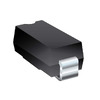
Why might the surface mount DO-214AB (SMC) package of the SMCJ17A-QH be advantageous for integration into compact electronic designs?
The surface mount DO-214AB (SMC) package of the SMCJ17A-QH supports high power density in minimal board space while maintaining thermal performance up to 150°C junction temperature, allowing the SMCJ17A-QH to fit dense layouts in portable or space-constrained systems without the bulk of larger leaded packages, though proper reflow soldering and thermal vias become essential for sustaining 1500W peak pulse ratings.
In comparison to bidirectional options in the SMCJ-Q series, how does the unidirectional nature of the SMCJ17A-QH affect its application in asymmetric transient protection scenarios?
In comparison to bidirectional options in the SMCJ-Q series, the unidirectional nature of the SMCJ17A-QH can lower overall leakage in one direction, enabling tighter design margins for circuits exposed to primarily one-way transients, while still delivering 27.6V clamping at 54.4A peak pulse current, though this limits versatility in fully symmetric surge environments.
What benefits does the AEC-Q101: qualification of the SMCJ17A-QH provide for long-term reliability in vehicle applications?
The AEC-Q101: qualification of the SMCJ17A-QH incorporates automotive-specific testing for temperature cycling, vibration, and mechanical robustness, ensuring the SMCJ17A-QH maintains its 18.9V breakdown and 27.6V clamp characteristics consistently under varying load conditions and extreme thermal profiles typical of automotive electronics.
What key trade-offs should engineers evaluate when selecting the SMCJ17A-QH for high-energy transient protection in designs with voltages near its standoff rating?
When selecting the SMCJ17A-QH for high-energy transient protection, engineers must balance its 17V standoff voltage against the 18.9V minimum breakdown and 27.6V clamping at 54.4A peak pulse current to minimize leakage in normal operation while ensuring the 1500W peak pulse power rating adequately handles expected surge energies, avoiding potential signal integrity issues in high-speed paths where nominal voltages approach 17V.