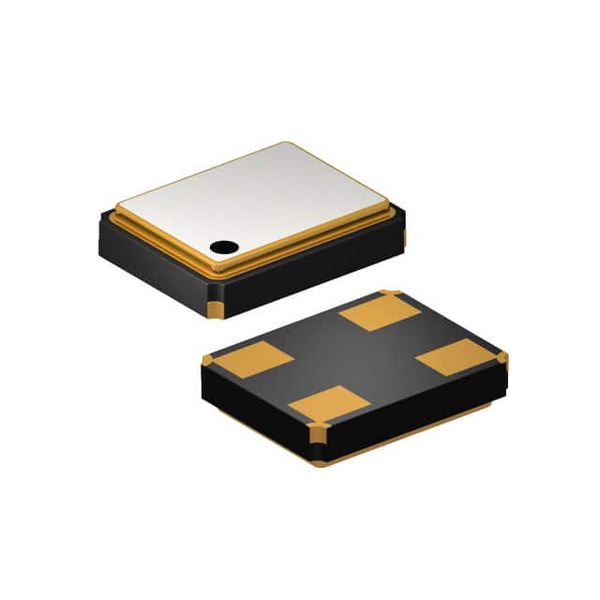
SXT32410BB38-26.000M are New and Original in Stock, Find SXT32410BB38-26.000M electronics components stock, Datasheet, Inventory and Price at Ariat-Tech.com Online, Order SXT32410BB38-26.000M Suntsu Electronics, Inc. with warrantied and confidence from Ariat Technology Limitd. Ship via DHL/FedEx/UPS. Payment with Wire Transfer or PayPal is OK.
Email us: Info@Ariat-Tech.com or RFQ SXT32410BB38-26.000M Online.
Frequently Asked Questions
How does the ±30ppm frequency stability of the SXT32410BB38-26.000M impact timing accuracy in clock circuits for embedded systems?The ±30ppm frequency stability of the SXT32410BB38-26.000M results in a maximum deviation of about 780 Hz, which keeps timing errors within acceptable limits for non-critical applications like general-purpose microcontrollers, supporting reliable operation without the need for more expensive ultra-stable alternatives.
Why is the 10pF load capacitance important for the SXT32410BB38-26.000M in parallel resonant oscillator designs?The 10pF load capacitance of the SXT32410BB38-26.000M ensures compatibility with standard inverter-based crystal oscillators by providing the right feedback capacitance, reducing frequency pulling effects and improving long-term stability in portable electronics where space is limited.
What power dissipation implications arise from the 50 Ohm ESR of the SXT32410BB38-26.000M when used in RF front-end circuits?The 50 Ohm ESR of the SXT32410BB38-26.000M introduces some resistive losses in the oscillator tank, typically adding 0.1 to 0.5 mW of power consumption depending on drive level, which is critical to account for in battery-operated wireless modules to maintain efficiency over extended operation.
Does the -30°C to 85°C operating temperature range of the SXT32410BB38-26.000M meet the requirements for industrial equipment with varying environmental conditions?The -30°C to 85°C operating temperature range of the SXT32410BB38-26.000M covers a broad spectrum of industrial scenarios, including those with moderate thermal gradients, but it may necessitate additional thermal management strategies for applications operating continuously near the maximum limit to prevent accelerated aging of the crystal.
How does the small 3.20mm x 2.50mm footprint of the SXT32410BB38-26.000M support miniaturization efforts in consumer electronics?The 0.126" L x 0.098" W (3.20mm x 2.50mm) size of the SXT32410BB38-26.000M enables dense packing on PCBs, often reducing component count and board area in slim devices like wearables or IoT sensors while still allowing for adequate grounding and routing around the pins.
How does the ±30ppm frequency stability of the SXT32410BB38-26.000M compare to crystals with ±50ppm stability in terms of timing drift over time?The ±30ppm frequency stability of the SXT32410BB38-26.000M offers approximately 40% less drift compared to ±50ppm crystals, making it a suitable upgrade for applications demanding tighter clock accuracy without significantly increasing unit cost in designs where ±100ppm overall system tolerance is acceptable.
How does the fundamental mode operation at 26 MHz affect the SXT32410BB38-26.000M's suitability for communication systems with strict harmonic requirements?Fundamental mode operation at 26 MHz for the SXT32410BB38-26.000M suppresses second and higher harmonics to levels typically below -60 dBc, which helps minimize interference in sensitive RF designs such as narrowband transceivers operating around that frequency.
In low-power designs, does the 50 Ohm ESR of the SXT32410BB38-26.000M favor certain oscillator configurations over others?The 50 Ohm ESR of the SXT32410BB38-26.000M is well-suited for series resonant or Pierce oscillator topologies that operate at low drive currents, helping to keep quiescent power below 50 uA in sleep states while ensuring the crystal starts reliably within its specified temperature envelope.
What considerations should engineers make when replacing higher-stability crystals with the SXT32410BB38-26.000M in existing timing-sensitive circuits?When migrating to the SXT32410BB38-26.000M, the ±30ppm frequency stability should be verified against the original requirement; this part allows for substantial BOM savings in high-volume production while still meeting most consumer and industrial timing needs as long as system-level error budgets are recalibrated accordingly.
How does the SMD construction of the SXT32410BB38-26.000M perform differently under thermal cycling compared to traditional leaded crystal packages?The SMD package of the SXT32410BB38-26.000M experiences reduced mechanical stress during thermal cycling due to its monolithic construction, potentially resulting in 2x longer fatigue life in applications involving repeated temperature excursions between -30°C and 85°C, such as in automotive or aerospace equipment.
onsemi has launched EliteSiC M4, its fourth-generation silicon carbide (SiC) platform based on a trench architecture designed to improve next-generati...
Building on decades of Arm Cortex-M innovation, Arm and STMicroelectronics are working together to bring intelligence closer to where machines interac...
Renesas Electronics introduced the RX74M and RX74N, two flagship 32-bit microcontrollers (MCUs) designed for industrial automation and energy infrastr...
Omnivision has expanded its industrial image sensor portfolio with the introduction of two backside-illuminated (BSI) global shutter CMOS sensors, the...
On April 19, 2026 (local time), media reports citing sources familiar with the matter revealed that Google, a subsidiary of Alphabet, is in talks with...
Texas Instruments TPS92542-Q1 Synchronous Boost Controller contains a synchronous boost controller and a two-channel monolithic synchronous buck LED d...
Toshiba TB67H453 Single Channel H-Bridge Driver has a current monitoring function with voltage feedback from the ISENSE output pin. The device's absol...
STMicroelectronics STSAFE-A120 Authentication ICs are highly secure integrated circuits designed to protect sensitive data and devices through advance...