Frequently Asked Questions
What makes the RN73R2ATTD2431B05 suitable for automotive applications, and how does AEC-Q200 qualification affect its reliability in vehicle electronics?
The RN73R2ATTD2431B05 carries AEC-Q200 qualification, which means it has undergone accelerated life testing, thermal cycling, and stress validation required for automotive-grade components. This qualification ensures the resistor maintains its ±0.1% tolerance across the extended operating range of -55°C to 155°C typical in automotive environments. AEC-Q200 certification addresses concerns about thermal shock during cold starts, underhood temperature fluctuations, and long-term drift that could compromise precision circuits in engine control modules, sensor interfaces, and power management systems. The thin-film construction of the RN73R2ATTD2431B05 supports this reliability requirement better than carbon-film alternatives, which typically exhibit larger tolerance drift under thermal stress.
How does the ±5ppm/°C temperature coefficient of the RN73R2ATTD2431B05 influence design decisions for precision measurement and signal conditioning circuits?
The RN73R2ATTD2431B05 exhibits a temperature coefficient of ±5ppm/°C, meaning its resistance changes by approximately 5 parts per million for every degree Celsius of temperature variation. Over the full -55°C to 155°C operating range (210°C span), this translates to a maximum drift of ±1,050 ppm, or roughly ±0.1% total change in the 2.43 kOhm value. For ratiometric circuits such as precision analog-to-digital converter input dividers, instrumentation amplifier gain networks, or threshold detection circuits, this low temperature coefficient ensures that ratios between resistor pairs remain stable. However, for absolute reference networks requiring better than 0.1% accuracy across temperature extremes, designers should consider using matched resistor pairs of the RN73R2ATTD2431B05 or implement additional temperature compensation. The thin-film technology underlying the RN73R2ATTD2431B05 achieves this low coefficient through laser-trimmed resistive paths, making it preferable to wirewound or carbon-composition alternatives for temperature-sensitive applications.
Why is the ±0.1% tolerance of the RN73R2ATTD2431B05 significant compared to standard ±1% or ±5% resistors, and what circuit topologies benefit from this precision?
The RN73R2ATTD2431B05 achieves ±0.1% tolerance, representing a 10-fold improvement over typical ±1% film resistors. This precision directly benefits circuits where resistor ratios determine system performance. In logarithmic amplifier input networks, the RN73R2ATTD2431B05 can establish accurate gain relationships without requiring manual trimming potentiometers. For current-sensing shunt circuits, the tight tolerance ensures predictable voltage drops across the 2.43 kOhm resistor, reducing measurement uncertainty in power monitoring and battery management systems. Precision filter design—including active low-pass, high-pass, and bandpass topologies—relies on resistor-capacitor ratios to set accurate corner frequencies; the RN73R2ATTD2431B05 minimizes frequency error that would otherwise require post-manufacture calibration. In medical instrumentation and industrial control systems, where measurement repeatability is critical, selecting the RN73R2ATTD2431B05 over standard-tolerance alternatives reduces the need for individual circuit calibration, lowering manufacturing cost and improving yield. The tight tolerance of the RN73R2ATTD2431B05 also supports ratio-matched pairs used in analog multiplexer control and temperature compensation networks.
What are the thermal management implications of the 0.125W (1/8W) power rating of the RN73R2ATTD2431B05 in continuous operation versus transient pulse conditions?
The RN73R2ATTD2431B05 is rated for 0.125W continuous power dissipation at 70°C ambient, with derating applied at higher temperatures. To calculate safe operating current, use the relationship: Power = I²R, yielding a maximum continuous current of approximately 7.2 mA at the 2.43 kOhm resistance. In circuits where the RN73R2ATTD2431B05 dissipates power continuously—such as voltage dividers supplying reference voltages or bias networks in analog circuits—ensure the resistor remains below 70°C ambient plus self-heating. Self-heating of the RN73R2ATTD2431B05 at rated power is typically 30–50°C, so the junction temperature would approach 100–120°C under worst-case ambient conditions. However, short-duration pulse conditions allow higher instantaneous power; the RN73R2ATTD2431B05 can tolerate brief transients exceeding the continuous rating without degradation, provided the average power remains within specification. For circuits involving periodic current spikes—such as signal conditioning front-ends with transient protection or precision measurement circuits with burst sampling—the RN73R2ATTD2431B05 offers margin beyond the nominal 0.125W rating. Designers should verify that PCB copper area around the RN73R2ATTD2431B05 provides adequate thermal coupling to the surrounding substrate to avoid local hot spots.
How does the thin-film construction of the RN73R2ATTD2431B05 compare to wirewound and carbon-film alternatives in terms of frequency response and high-frequency circuit performance?
The RN73R2ATTD2431B05 employs thin-film technology, where a resistive metal-oxide layer is deposited on a ceramic substrate and laser-trimmed to achieve the 2.43 kOhm value and ±0.1% tolerance. This construction method produces very low parasitic inductance compared to wirewound resistors, making the RN73R2ATTD2431B05 suitable for high-frequency signal paths where inductive reactance would introduce phase shifts or impedance discontinuities. In RF front-end circuits, impedance matching networks, and pulse-shaping circuits operating above 100 MHz, the RN73R2ATTD2431B05 maintains resistive behavior without the inductive artifacts typical of wirewound alternatives. The thin-film structure of the RN73R2ATTD2431B05 also exhibits superior noise performance compared to carbon-composition resistors; noise is primarily Johnson (thermal) noise, without the flicker noise component present in carbon films. For precision transimpedance amplifier input networks, low-noise preamplifiers, and measurement circuits where noise figure is critical, the RN73R2ATTD2431B05 delivers lower voltage noise density than equivalent carbon-film resistors. The 0805 (2012 metric) package size of the RN73R2ATTD2431B05 also contributes to lower parasitic effects than larger packages, supporting applications in compact signal conditioning modules.
What is the moisture sensitivity rating of the RN73R2ATTD2431B05, and how does MSL 1 classification affect assembly, storage, and field reliability?
The RN73R2ATTD2431B05 carries a Moisture Sensitivity Level (MSL) rating of 1 (Unlimited), indicating that moisture ingress does not degrade the component during typical handling, assembly, and storage conditions. This classification means the RN73R2ATTD2431B05 requires no baking before reflow soldering, no dry-pack packaging, and no time-to-assembly restrictions. For manufacturers operating high-volume production lines or managing extended component inventory, the RN73R2ATTD2431B05 eliminates the need for moisture-controlled storage cabinets or moisture-barrier bag monitoring. In field applications involving high humidity, coastal environments, or equipment exposed to condensation cycles, the moisture-resistant thin-film technology of the RN73R2ATTD2431B05 prevents degradation of the resistive element. The robust construction allows the RN73R2ATTD2431B05 to maintain its ±0.1% tolerance and AEC-Q200 reliability characteristics even when exposed to intermittent moisture or condensation, reducing the risk of intermittent failures in outdoor or industrial equipment. This characteristic makes the RN73R2ATTD2431B05 particularly advantageous for automotive underhood applications where thermal cycling drives moisture absorption into component packages.
For the 2.43 kOhm value, what are typical voltage divider, bias network, and current-limiting applications where the RN73R2ATTD2431B05 provides optimal performance trade-offs?
The 2.43 kOhm resistance value of the RN73R2ATTD2431B05 occupies a practical midpoint for precision analog circuit design. In voltage divider networks, a 2.43 kOhm upper leg paired with a complementary lower resistor allows 3.3V or 5V digital logic outputs to interface with 0–10V analog sensor inputs using mathematically simple ratios; for example, a 2.43 kOhm resistor in series with a 5.6 kOhm load resistor yields a 0.3× attenuation factor useful for data acquisition front-ends. The RN73R2ATTD2431B05 also works well as a bias resistor in single-supply operational amplifier configurations where moderate input bias current (typically <1 µA at the 2.43 kOhm value) maintains low input offset voltage. For transimpedance amplifier feedback networks converting photodiode current to voltage, the 2.43 kOhm feedback resistor of the RN73R2ATTD2431B05 supports moderate transimpedance gain (2.43 kV/A) while maintaining bandwidth suitable for sensors with response times above 100 µs. In precision current-to-voltage converter stages or Howland charge pump bias networks, the RN73R2ATTD2431B05 pairs well with precision operational amplifiers, where its ±0.1% tolerance ensures predictable gain coefficients without requiring calibration trimmers. The 2.43 kOhm value also appears frequently in precision instrumentation amplifier gain-setting networks, where matched pairs of the RN73R2ATTD2431B05 establish stable gain ratios independent of PCB layout parasitic effects.
How do the dimensional specifications and package footprint of the RN73R2ATTD2431B05 0805 (2012 metric) influence PCB layout, thermal dissipation, and high-density circuit integration?
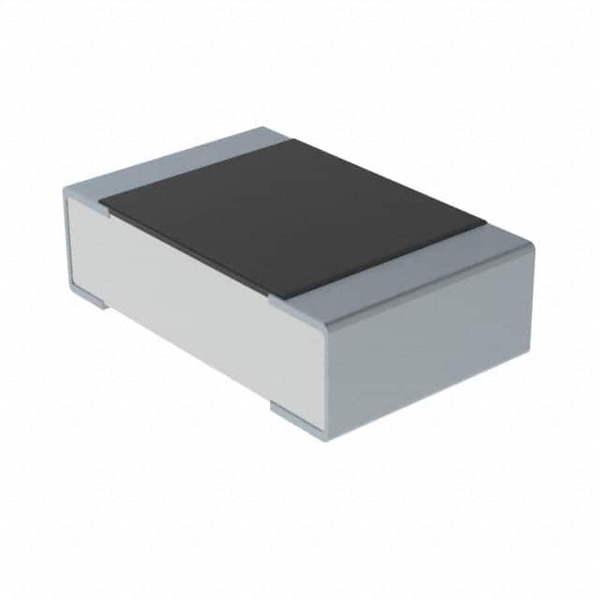
The RN73R2ATTD2431B05 is packaged in the 0805 (2012 metric) form factor, measuring 2.00 mm length × 1.25 mm width with a maximum seated height of 0.60 mm. This compact geometry enables high-density PCB layout, allowing multiple precision resistor networks to occupy minimal board area in space-constrained applications such as portable instrumentation, automotive sensor modules, and IoT edge devices. The low profile of the RN73R2ATTD2431B05 supports stacking or routing traces beneath the component footprint in multilayer PCBs, reducing total board size. From a thermal perspective, the small footprint of the RN73R2ATTD2431B05 concentrates its 0.125W power dissipation into a limited area; designers must ensure adequate copper area on the inner layers and ground plane connectivity to distribute heat effectively. The 0805 package of the RN73R2ATTD2431B05 is readily solderable using standard reflow equipment and automated pick-and-place machines, with excellent yield rates in high-volume manufacturing. Rework and manual soldering of the RN73R2ATTD2431B05 are feasible but require fine-tip soldering irons due to the compact lead spacing. The standardized footprint of the RN73R2ATTD2431B05 is compatible with most schematic libraries and PCB layout tools, reducing design-cycle risk and supporting cross-team collaboration.
What design considerations apply when substituting the RN732ATTD2431B05 alternative resistor for the RN73R2ATTD2431B05, and are there functional or reliability differences?
The RN732ATTD2431B05 is identified as a substitute for the RN73R2ATTD2431B05 within the KOA Speer RN73 thin-film resistor family. Both resistors share the same 2.43 kOhm resistance value, ±0.1% tolerance, 0805 package geometry, and automotive AEC-Q200 qualification. The substitution is electrically and mechanically direct; circuits designed around the RN73R2ATTD2431B05 can accept the RN732ATTD2431B05 without redesign. However, the second and third characters of the part number (RN73 versus RN732) may indicate differences in substrate material, termination plating, or temperature coefficient performance within KOA's product matrix. Before implementing a bulk substitution from RN73R2ATTD2431B05 to RN732ATTD2431B05, verify that all specification differences—including temperature coefficient, frequency behavior, and moisture resistance—remain acceptable for the target application. If purchasing for precision filter networks or temperature-compensated circuits, confirm that the substitute resistor matches the ±5ppm/°C temperature coefficient of the RN73R2ATTD2431B05. For cost-sensitive high-volume projects, the RN732ATTD2431B05 may offer supply-chain advantages; however, qualification testing with the RN732ATTD2431B05 in critical automotive or medical applications is recommended before production commitment.
What RoHS and REACH compliance status of the RN73R2ATTD2431B05 implies for supply-chain sustainability and international market availability?
The RN73R2ATTD2431B05 carries RoHS3 compliance and REACH Unaffected status. RoHS3 compliance indicates that the resistor meets European Restriction of Hazardous Substances Directive requirements, eliminating lead, cadmium, mercury, hexavalent chromium, and certain brominated flame retardants from the manufacturing process. This compliance of the RN73R2ATTD2431B05 supports market entry into the European Union and countries adopting similar standards, including Canada and Turkey. The REACH Unaffected classification means the RN73R2ATTD2431B05 is not subject to REACH (Registration, Evaluation, Authorisation and Restriction of Chemicals) substance restrictions, simplifying compliance documentation and supply-chain auditing. For manufacturers targeting automotive, industrial control, and consumer electronics markets with global distribution, specifying the RN73R2ATTD2431B05 eliminates the need for dual part numbers or region-specific sourcing. The long-term sustainability of RN73R2ATTD2431B05 availability is supported by its compliance posture; components not meeting RoHS or REACH requirements face increasing obsolescence risk as environmental regulations tighten globally. The RN73R2ATTD2431B05 design is aligned with modern supply-chain expectations, reducing the risk of mid-production phase-out that would necessitate costly circuit redesigns or alternative component qualification.
How does the tape-and-reel (TR) packaging of the RN73R2ATTD2431B05 affect automated assembly efficiency and minimum order quantities for production runs?
The RN73R2ATTD2431B05 is supplied in Tape & Reel (TR) format, which uses a standardized 8 mm or 12 mm plastic carrier tape wound on reels. Tape-and-reel packaging enables direct feeding into pick-and-place automation equipment, eliminating manual component handling and dramatically improving assembly throughput compared to tube or bulk packaging. The RN73R2ATTD2431B05 on standard reels accommodates typical production volumes of 500–10,000 units, matching the scale of contract manufacturing and medium-volume OEM operations. Reel quantities and tape specifications for the RN73R2ATTD2431B05 are consistent with industry standards, ensuring compatibility across different assembly houses and geographic regions. For small prototype or pilot batches, the RN73R2ATTD2431B05 may also be available in cut-tape or tube packaging at higher per-unit cost; this flexibility supports design validation phases without committing to full-reel quantities. The TR format of the RN73R2ATTD2431B05 also simplifies supply-chain logistics, as reel dimensions and handling procedures are standardized, reducing the risk of mispicks or component damage during automated material handling.
What failure modes or long-term drift characteristics should design engineers anticipate from the RN73R2ATTD2431B05 in high-temperature or high-stress environments?
Thin-film resistors like the RN73R2ATTD2431B05 exhibit excellent long-term stability but can experience gradual resistance drift if exposed to sustained temperatures near the 155°C upper limit or if subjected to mechanical stress during assembly. The primary failure mode is drift in the resistive element itself; the ±0.1% initial tolerance of the RN73R2ATTD2431B05 may degrade to ±0.3–0.5% after thousands of hours at 150°C, depending on circuit current and voltage stress. For applications operating continuously at or near 155°C—such as under-hood automotive circuits or industrial high-temperature sensors—the RN73R2ATTD2431B05 remains stable over typical 5–10 year vehicle lifespans, but periodic measurement or in-circuit resistance monitoring may be warranted for mission-critical precision networks. Mechanical stress during solder reflow or thermal cycling can induce micro-cracks in the thin-film layer; the RN73R2ATTD2431B05 AEC-Q200 qualification validates performance through 1,000+ thermal cycles (-55°C to 155°C), establishing confidence for automotive environments. Moisture-induced corrosion of terminations, though unlikely given the MSL 1 rating of the RN73R2ATTD2431B05, can occur if the component is stored improperly or if PCB humidity remains elevated post-assembly; proper reflow profiles and controlled moisture levels during board assembly mitigate this risk. For precision circuits requiring 0.1% tolerance maintenance over multi-year operating windows, periodic calibration or drift budgeting for the RN73R2ATTD2431B05 is prudent in aerospace, medical instrumentation, or high-reliability industrial applications.